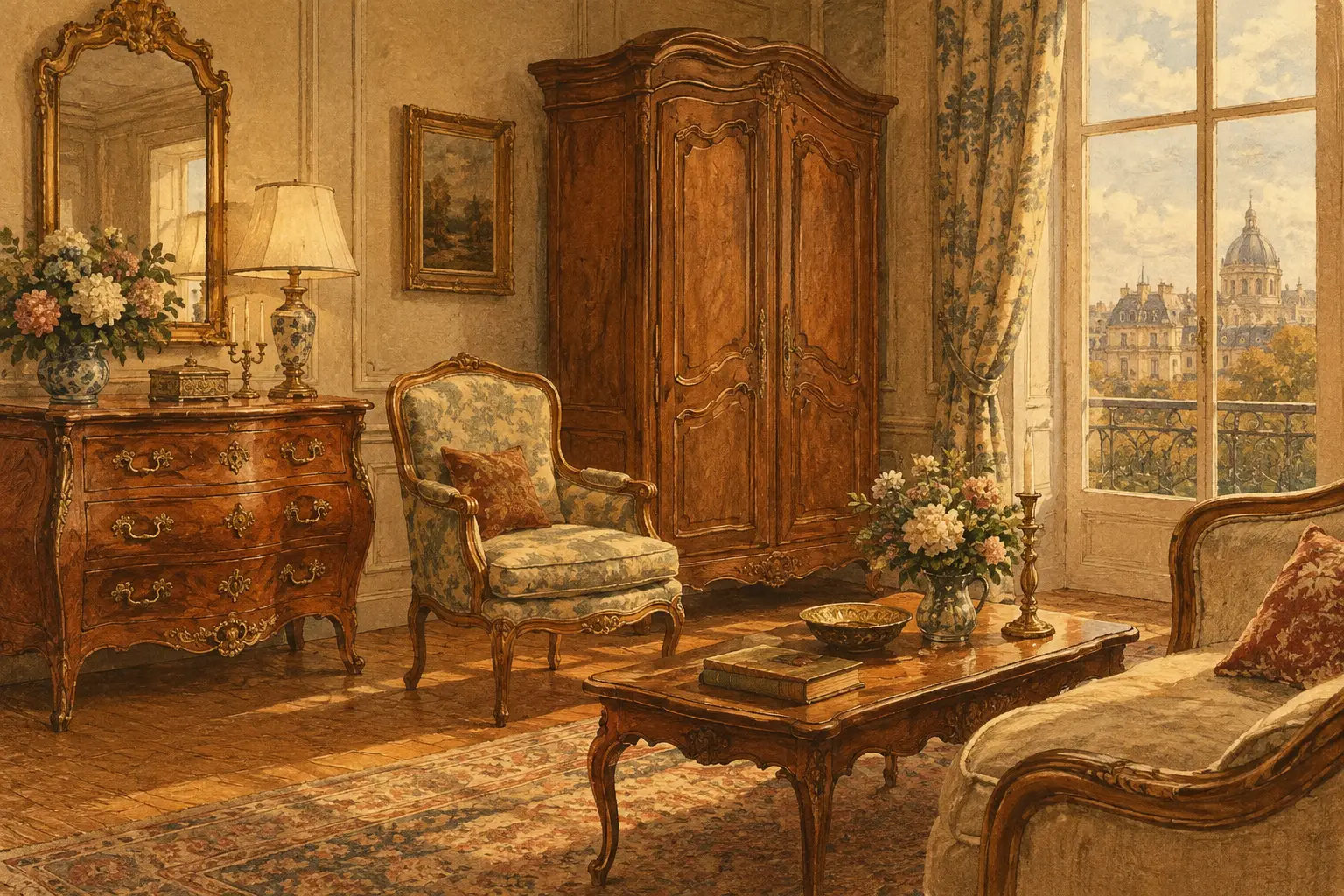
A fine French commode can change the temperature of a room. Its figured veneer, original gilt-bronze mounts and gently worn marble top offer a richness that flat-pack furniture cannot imitate. This French antique furniture guide is for buyers who want that character, but also want to understand what they are bringing home: the period, the construction, the condition and the practical realities of living with an object that may be two centuries old.
French furniture is not one uniform look. A restrained Louis XVI fauteuil and an exuberantly carved Louis XV bergère may both be French, yet they ask very different things of a room. Learning to recognise those distinctions makes buying more enjoyable and helps you choose a piece with lasting decorative purpose rather than simply an attractive silhouette.
Begin with the French furniture periods
The most useful starting point is proportion. French furniture changed markedly from the late 17th century through the 19th century, responding to shifts in court taste, architecture and social life. You do not need to memorise every reign, but a working knowledge of the principal styles will give a clearer eye.
Louis XIV: formal scale and rich materials
Louis XIV furniture is architectural, symmetrical and designed to impress. Expect heavy forms, bold carving, marquetry, dark woods and gilt-bronze detail. Cabinet furniture may feature tortoiseshell and brass boulle work, while seating has upright grandeur rather than casual comfort. Original examples are scarce and significant, but later pieces made in this manner can still bring useful gravitas to a hall, library or formal dining room.
Régence and Louis XV: movement, comfort and rococo detail
During the Régence period, forms became lighter and curves began to replace rigid symmetry. Under Louis XV, the rococo style flourished. Cabriole legs, asymmetrical carving, scrolling aprons and serpentine-fronted commodes are hallmarks. Chairs were made with comfort in mind, often with a lower seat and more accommodating back.
This is furniture with a romantic, animated quality. A single walnut Louis XV-style table or painted fauteuil can sit beautifully in a contemporary room, where its curves soften clean-lined architecture. A complete suite, however, can feel overly ornate in a modest space unless balanced with plain walls, simple upholstery and quieter surrounding objects.
Louis XVI and Directoire: classical restraint
By the later 18th century, archaeological discoveries and a renewed interest in antiquity brought a cleaner, more ordered vocabulary. Louis XVI furniture is recognisable for straight, fluted legs, oval or rectangular forms, ribbon motifs, rosettes and neoclassical carving. Mahogany, painted beech and finely veneered fruitwoods were widely used.
For many British homes, this is among the easiest French styles to live with. A Louis XVI console or small marble-topped guéridon has delicacy without visual clutter. Directoire furniture, which followed the Revolution, is often more spare and severe, with stronger lines and less ornament. It works particularly well alongside mid-century furniture, provided the materials and scale are thoughtfully matched.
Empire and 19th-century revival styles
Empire furniture is bolder again, with mahogany, columns, lions’ paws, laurel wreaths and gilt-bronze mounts inspired by imperial Rome and Egypt. It has great presence, although its scale can be demanding. In a smaller room, a single Empire occasional table or mirror often has more impact than a large cabinet.
The 19th century also revived earlier French styles. Napoleon III pieces may combine Louis XV curves, ebonised finishes, brass inlay, boulle decoration and theatrical upholstery. These are not lesser simply because they are later. A well-made 19th-century piece has its own history and can be a superb decorative choice, but it should be described and priced honestly as such rather than presented as 18th-century furniture.
A French antique furniture guide to materials and making
Look beyond surface decoration. Quality is often revealed by the choices a maker made where no one was expected to look.
Solid walnut, oak and fruitwood are common in provincial furniture, valued for their warmth and strength. Finer Parisian cabinetmaking frequently used veneers of mahogany, kingwood, tulipwood, satinwood or rosewood laid over a carcass, sometimes in intricate marquetry. Veneer is not a weakness in itself. On high-quality furniture, it is a deliberate and highly skilled decorative technique.
Turn a drawer over where possible. Hand-cut dovetails, unevenly spaced marks from hand tools and timber that has naturally darkened with age can be encouraging signs. Drawer bottoms are often set into grooves rather than fixed with modern staples. Old repairs, small patches and a slightly irregular fit can be entirely appropriate. They are evidence of a long working life, not automatically a reason to walk away.
Bronze or brass mounts deserve close attention. Original gilt-bronze mounts usually have crisp casting and a convincing relationship to the timber beneath them. Later replacements may be perfectly serviceable, but should be disclosed. The same applies to locks, escutcheons, handles and marble tops. A restored or replaced element can be sensible conservation, particularly on furniture intended for daily use, yet it affects originality and value.
Patina is not neglect
The most persuasive antiques have surfaces that show age honestly. Patina may include softened edges, mellowed timber, subtle fading, small old marks and a finish that has gained depth over time. It should not be confused with grime, unstable veneer, active woodworm or water damage.
Be cautious of furniture stripped back to raw pale wood, heavily stained to appear older, or polished to a mirror-like shine that obscures its character. A sympathetic waxed finish may be suitable for many pieces, while shellac or French polish can be correct for others. The right approach depends on the period, timber and existing surface. Over-restoration can remove the very evidence that makes an antique distinctive.
Upholstered chairs need a slightly different assessment. Springs, webbing and stuffing can be renewed without compromising the integrity of the frame, and fresh fabric is often the most practical route for domestic use. Ask whether the frame is sound, whether joints have been strengthened and whether the upholstery is recent. A chair can be beautifully re-covered but still require structural attention.
Choosing a piece that works at home
Measurements matter more than photographs suggest. French furniture can be elegantly scaled, but marble tops, projecting handles and curved fronts add depth. Measure access through doorways, stairwells and turns before committing, especially for armoires, commodes and mirrors. Also consider the floor beneath: a substantial antique armoire on uneven boards may need professional positioning or discreet support.
Think about use before rarity. A rare bureau may be the right purchase for a collector, but a sturdy provincial farmhouse table might better serve a family kitchen. Similarly, a formal salon chair can be an excellent accent piece, while a pair of comfortable fauteuils may be more useful by a fireplace. Antiques earn their place when their beauty and function meet.
French furniture rarely needs a fully period setting. A walnut commode against limewashed walls, a gilt mirror above a simple mantelpiece, or a painted provincial cupboard in a contemporary kitchen can create more interest than a room furnished in one strict style. The contrast gives the antique room to speak. Repeat one material or colour elsewhere – aged brass, warm timber, linen, black lacquer – and the scheme will feel composed rather than accidental.
Provenance, condition and honest value
Provenance can range from a documented maker, collection or sale history to a more modest but credible account of origin. A stamp from a known ébéniste, a retailer’s label or an old inventory number may be useful, but none should be treated as proof without context. Stamps can be faint, later applied or associated with workshops rather than an individual hand.
Condition is equally central to value. Originality, quality of construction, rarity, condition and desirability all play a part, and they do not always point in the same direction. An exceptional 18th-century commode with restorations may hold greater historical interest than a pristine later copy. Conversely, a beautifully made 19th-century provincial cupboard may offer more decorative value for the budget and stand up better to daily life.
A trusted dealer should describe materials, dimensions, repairs and visible condition plainly. At MN Interior Antiques, this kind of careful presentation matters because a good purchase begins with knowing what is original, what has been sensitively restored and what makes a piece worth choosing.
Care that respects the furniture
Keep antique timber away from radiators, strong direct sunlight and rapid swings in humidity. Central heating can dry joints and veneers; damp rooms can encourage movement and lifting. Use coasters on marble and timber, lift rather than drag furniture, and avoid silicone sprays that leave residues and complicate future conservation.
For routine care, a soft dry cloth is usually enough. Wax should be used sparingly and only when appropriate to the existing finish. If a drawer sticks, a lock fails or veneer begins to lift, resist the temptation to force it or apply household glue. A skilled restorer can often make a small intervention before it becomes a large repair.
The best French antiques retain a sense of their first life while becoming part of yours. Choose the piece whose scale, workmanship and surface you genuinely respond to, then give it a place where its history can be seen and enjoyed every day.