A clock is one of the few decorative objects that asks to be noticed every day. Its case catches the changing light, its dial brings order to a mantel or hall table, and, if the movement is running, its measured tick becomes part of the room. The appeal of antique clocks is not simply their age. It is the meeting of cabinet-making, metalwork and mechanical ingenuity in an object made to mark a life in passing hours.
For a home furnished with personality rather than uniformity, an old clock can provide an immediate focal point. A restrained Georgian bracket clock gives gravitas to a bookcase; a painted French clock softens a bedroom; an Arts and Crafts example brings honest material character to a shelf or sideboard. The right piece need not make an interior feel like a period room. Often, it is the contrast between an old timepiece and contemporary art, clean-lined furniture or rich modern colour that makes both more interesting.
Why antique clocks still belong in modern interiors
Antique clocks were designed as useful domestic objects, but their decorative value is equally lasting. A good case might be veneered in figured mahogany, made from oak with a mellow patina, or dressed with brass stringing, ormolu mounts or delicate painted detail. Even a modest example can have a pleasing silhouette and a dial with the slight irregularities that printed reproductions rarely capture.
Their scale also makes them unusually versatile. A carriage clock can add detail to a desk, bedside table or collection of books. A mantel clock anchors a chimney breast or console. A longcase clock needs more commitment, both in space and in maintenance, but offers an architectural presence that few other pieces can match.
Age alone does not make a clock desirable. Craftsmanship, proportion, condition and originality matter more than a broad date. A well-made late Victorian mantel clock with an attractive case and honest wear may be a far more rewarding purchase than an earlier clock that has been heavily altered or poorly repaired. The aim is not to buy the oldest object in the room, but the one that brings the most character to it.
The main types of antique clocks to know
Longcase and grandfather clocks
Longcase clocks became a feature of British homes from the late seventeenth century onwards. Their tall timber cases were often locally made, while the movement and dial might come from a specialist clockmaker. This creates a rich field for collectors: regional woods, painted country dials, moon-phase complications and distinguished maker names can all affect interest and value.
They are best suited to a hallway, dining room or larger sitting room where the case has breathing space. Before buying, measure ceiling height as well as floor space. Check that the hood, trunk and base belong together, as composite examples are not unusual. A longcase clock can be a wonderful statement, but it is not the most practical choice for a narrow modern hall or a home where regular winding will be forgotten.
Bracket, mantel and portico clocks
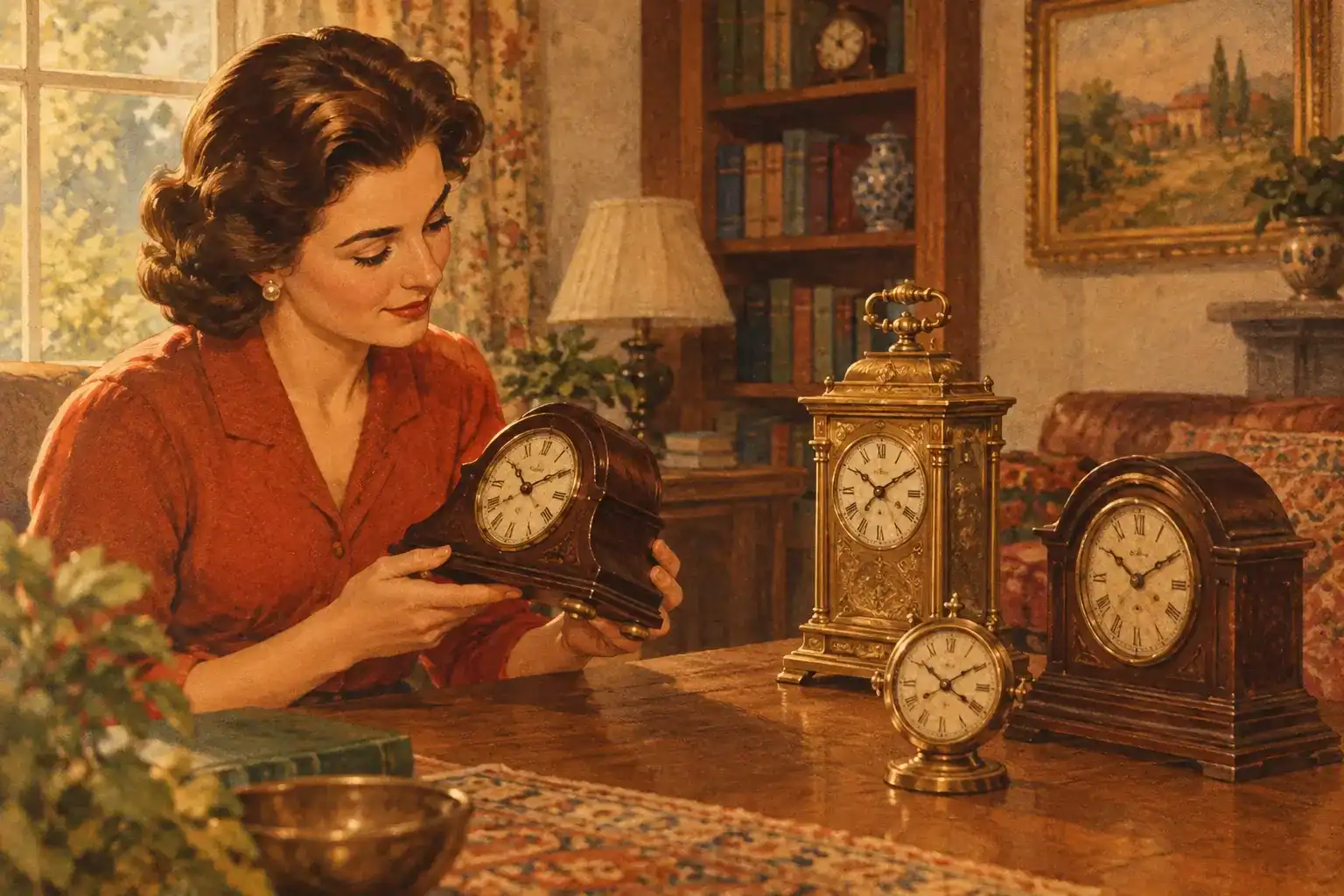
For many homes, mantel clocks offer the most approachable entry point. British bracket clocks were traditionally wall-mounted on a purpose-made bracket, though many now sit comfortably on shelves and cabinets. Their architectural cases, often in walnut or mahogany with brass details, work particularly well alongside antique furniture or as a counterpoint to mid-century pieces.
French mantel clocks span a wide range, from elegant Empire forms with gilt bronze mounts to nineteenth-century marble, slate and alabaster examples. Portico clocks, with their columns and visible pendulum, are more theatrical and make a strong focal point. Consider the visual weight of the case as carefully as the movement. Dark marble can look superb against pale walls, while gilded metal may be most effective when used sparingly in a quieter scheme.
Carriage, alarm and smaller table clocks
Small clocks reward close looking. A brass carriage clock, developed for travel, has a compact, practical form and often a clear enamel dial. It can sit naturally in both traditional and contemporary interiors. Alarm clocks, miniature travelling clocks and small wooden table clocks are equally useful where surface space is limited.
Their modest size should not be mistaken for simplicity. Look for crisp engraving, sound bevelled glass, cleanly fitted doors and a dial that has not been unnecessarily repainted. A little rubbing to brass is generally part of the piece’s history. Bright, over-polished metal can remove the softness and depth that made the clock appealing in the first place.
How to assess antique clocks before buying
The first question is whether you want a clock chiefly as an object, a working timepiece, or both. A non-running clock with a beautiful original case may still be worth considering for decorative use, provided its condition and price reflect that fact. If dependable timekeeping is essential, allow for a professional service unless there is clear evidence that one has been completed recently.
Start with the case. Look for cracks, losses, loose veneer, replaced feet and repairs that interrupt the line of the piece. Some restoration is expected in an object that may be a century or two old. The distinction is between sensitive conservation and alteration that has erased character. An old repair done well can be preferable to an untouched but unstable case.
Then examine the dial and hands. Hairline cracks to enamel, small chips and gentle discolouration can be acceptable, depending on the clock’s age and price. Repainted dials deserve closer scrutiny, particularly where lettering, numerals or maker details appear too sharp or inconsistent with the rest of the object. Hands are often replaced over a clock’s life, but should suit the period and sit correctly on the dial.
The movement deserves professional attention if you are unsure. A clock may tick briefly when moved or wound but still need proper cleaning, adjustment or repair. Ask whether it runs, strikes if applicable, keeps reasonable time and has all relevant components, including pendulum, key, winding arbor and any bell or gong. A missing pendulum can be solved in some cases, but it is not a trivial detail.
Provenance can add interest, especially for named makers, retailer labels or clocks with regional connections. It should be treated as supporting evidence, not a substitute for condition. At MN Interior Antiques, the most compelling pieces are those where design, honest age and clear presentation align, whether or not they carry a celebrated name.
Placing an antique clock with confidence
A clock needs a stable surface away from persistent vibration. Avoid placing it directly above a working radiator, beside a steamy kitchen zone or in strong, prolonged sunlight. Timber can move with changes in humidity, while lacquer, veneers and painted surfaces can fade or lift under harsh conditions.
For a mantel clock, leave enough visual space around it to appreciate the outline of the case. A pair of candlesticks, a small ceramic vessel or a framed picture can create a considered arrangement, but avoid crowding the clock with unrelated ornaments. The dial should remain easy to see. A longcase clock works best when it feels deliberately placed rather than pushed into a corner.
Think about dialogue between materials. A brass carriage clock beside textured pottery brings warmth to a desk. A dark oak clock can give structure to a room with linen upholstery and pale walls. Marble clocks sit beautifully with architectural salvage, stoneware and aged timber. These combinations feel collected over time because they are connected by material, texture or patina rather than a rigid matching rule.
Care, winding and the value of restraint
Most antique clocks benefit from less intervention, not more. Dust the case with a soft dry cloth and avoid household sprays, abrasive metal polishes and oils applied to the movement. A clock movement requires specialist clock oil in very small quantities and only where appropriate. General-purpose lubricants can attract dust, gum up pivots and create more expensive problems later.
If the clock is in working order, follow the winding direction and routine advised by the seller or restorer. Wind gently and do not force a key. When moving a pendulum clock, secure or remove the pendulum first and carry the case upright where possible. For striking clocks, resist repeatedly advancing the hands to test the mechanism, as this can damage parts or put the striking train out of sequence.
A regular service by a skilled horologist is a sensible investment for a clock you intend to run. The interval depends on the movement’s condition, use and environment, but a clock that begins to lose time dramatically, stops without cause, sounds uneven or feels difficult to wind should be checked rather than coaxed into working.
The best antique clock is not necessarily the rarest, grandest or most complicated. It is the one whose proportions please you, whose condition has been honestly understood, and whose presence changes the way a room feels. Let it show its age with dignity, give it the care it deserves, and it will continue telling its story long after it has told the time.