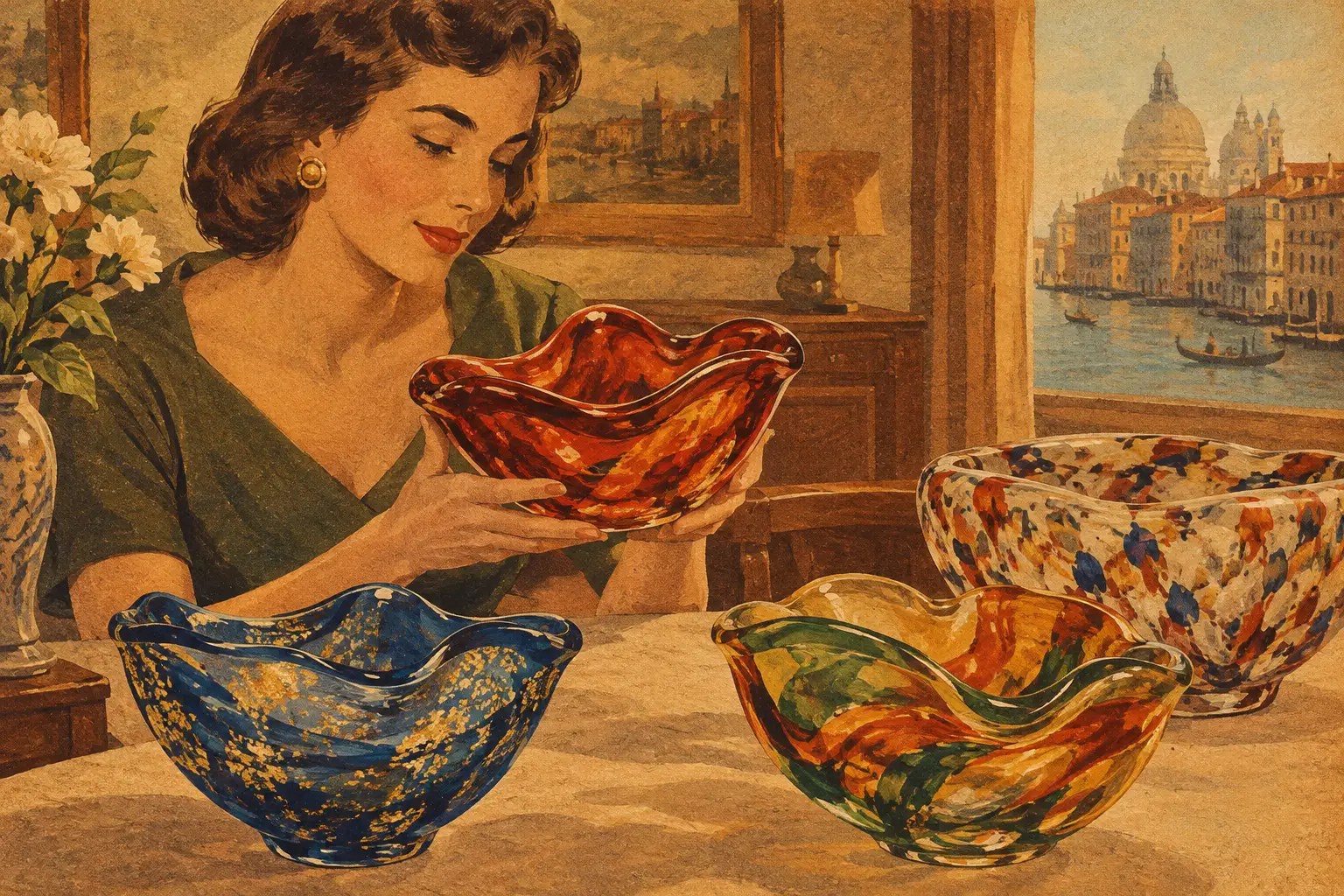
A Murano glass bowl can change the temperature of a room before anything is placed inside it. Light catches a folded rim, a ribbon of latticino twists through clear glass, or a deep amber ground glows against a dark timber sideboard. Unlike a purely functional serving bowl, a well-chosen Murano example is an object to live with and look at: part Venetian craft tradition, part sculptural accent, and often a record of a particular design moment.
For collectors and homeowners, the appeal lies in that balance. Murano glass has an unmistakable sense of occasion, but the right piece need not feel formal or fragile in a modern interior. The key is understanding what you are looking at, what condition is appropriate for its age, and how its colour and scale will work in your home.
What makes a Murano glass bowl distinctive?
Murano is an island in the Venetian lagoon with a glassmaking history extending back centuries. Over time, its furnaces developed and refined techniques that remain central to the identity of Venetian art glass: hand-blown forms, layered colour, gold leaf, filigree canes, controlled bubbles and complex surface decoration.
That heritage matters because Murano is not simply a look. A bright, freeform bowl may be described as “Murano style”, yet that does not automatically mean it was made on Murano. Equally, an authentic vintage piece is not necessarily signed. Paper labels disappear, etched signatures can be faint, and many workshop-made objects were originally sold without a permanent maker’s mark.
A convincing bowl should reward close inspection. Its shape may show the slight asymmetry of hand-forming, especially around a pulled or ruffled edge. Colours should appear integral to the glass rather than painted on the surface. In pieces made with aventurine, tiny metallic flecks give the glass a gentle, mineral sparkle; in sommerso glass, one colour appears suspended within another, creating unusually rich depth at the rim and base.
Techniques vary considerably. Latticino uses fine white or coloured threads within clear glass. Murrine incorporates slices of patterned glass cane, often forming floral, star-like or geometric motifs. Pulegoso glass has a deliberately bubbled, textured appearance, while incalmo joins different coloured sections of blown glass. Knowing these terms is useful, but a bowl should not need a long technical description to earn its place. Form, colour and condition come first.
Choosing a Murano glass bowl for your interior
Begin with where the bowl will sit, rather than with a vague idea of filling it. A low, wide centrepiece needs visual weight and enough presence to hold a dining table without interrupting conversation. A tall, folded bowl is often better on a mantelpiece, console or open shelf, where its outline can be appreciated from the side. Small dishes work beautifully on a bedside table, dressing table or hall table for keys, jewellery or nothing at all.
Colour deserves the same consideration as shape. Clear, smoked and soft amber glass sits easily with antique oak, walnut and brass. Cobalt, ruby, jade and opaque white create a stronger focal point, particularly in rooms with restrained walls and upholstery. If your interior already includes expressive ceramics – perhaps West German pottery or hand-painted antique ceramics – choose a bowl that echoes one colour within the grouping rather than competing with every surface.
There is no rule that a Murano bowl must be used as a fruit bowl. In fact, overfilling a decorative example can conceal its best features. A few quince, lemons or pears can be effective in a substantial open bowl, but a delicate filigree or murrine piece is often most striking when left empty. On a coffee table, it can act as a small pool of colour among books, a vintage lamp and a favourite object with patina.
Scale is where many otherwise good choices falter. Measure the furniture, not only the available space. A small bowl can disappear on a broad refectory table, while an expansive, highly coloured centrepiece may overwhelm a narrow console. Consider sightlines too. The most dramatic profile is not always the most practical choice beneath a pendant light or opposite a television.
How to assess age, authenticity and condition
Buying vintage glass calls for a measured eye. Original labels, etched signatures, workshop attribution and a clear provenance are all helpful, but none should be treated as the only proof of origin. Labels can be reproduced, and a lack of label is common on genuine older glass. A trustworthy description should be careful about certainty, distinguishing between a documented maker, an informed attribution and a piece described more broadly as Venetian or Murano-style.
The base can reveal much. Look for a finished pontil area, natural wear from use and a polished finish appropriate to the form. A very sharp, rough underside may indicate a later break or poor finishing, although hand-made glass can retain small irregularities. These are not necessarily faults. Fine bubbles, slight variation in thickness and a subtly uneven rim are often part of the making process rather than damage.
Condition should be judged in proportion to age, rarity and price. A tiny surface scratch on a large, mid-century decorative bowl may be acceptable and even expected. A crack, deep chip, impact bruise or poorly ground rim is more serious because it affects both appearance and structural confidence. Hold the piece to natural light if possible. Repairs can be difficult to spot under artificial lighting, and internal fractures may show as a pale, feathery line.
It is worth asking direct questions before purchasing: Is there a signature or surviving label? Are there any chips, cracks or restoration? What are the exact measurements? Has the condition been photographed clearly? A curated antique dealer should answer plainly, including imperfections that form part of the object’s history. At MN Interior Antiques, that straightforward approach matters as much as the decorative appeal of the piece itself.
Styling vintage Murano glass without making it feel precious
Murano glass works especially well when it is allowed a little breathing room. A bowl placed alone on a walnut chest can provide the colour and movement a room needs. If you prefer a collected display, combine it with materials that create contrast: aged wood, woven linen, travertine, silverplate or matte ceramic. The changing light on glass becomes more noticeable beside surfaces that absorb rather than reflect it.
A pair of lamps can frame a bowl on a sideboard, provided the overall arrangement does not become too symmetrical or crowded. On a dining table, use it as the central object and keep candles or seasonal foliage low. In a cabinet, place it at a slight angle so that its profile is visible rather than presenting only its opening to the room.
Be selective with other colourful glass. Several unrelated pieces can feel like a shop display rather than a considered interior. A shared tone – sea green, tobacco, amethyst or warm amber – gives a group coherence. Alternatively, let one exceptional bowl carry the colour while surrounding objects remain quieter.
Caring for a vintage glass bowl
Hand-washing is the safest choice. Use lukewarm water, a mild washing-up liquid and a soft cloth, then dry carefully with a lint-free towel. Avoid sudden changes in temperature: pouring very hot water into cool glass, or rinsing a warm bowl under cold water, can put stress on the material.
Dishwashers are best avoided, particularly for older pieces, gilded decoration and bowls with applied details. Abrasive cleaners can dull the surface and leave fine scratches that show under daylight. Store bowls where they cannot knock against one another, and lift them with two hands if the form is broad or heavy. Decorative handles and pulled points are not designed to bear the full weight.
A Murano bowl earns its place through character, not perfection. Choose one whose colour, hand-worked form and honest signs of age make you look twice each time you pass it. That is how a collectible object becomes part of a home: not hidden away for safety, but thoughtfully placed, properly cared for and enjoyed in the changing light.