A single well-chosen vase can do more for a mantelpiece or sideboard than a shelf full of forgettable accessories. German pottery, particularly the boldly glazed West German work of the 1950s to 1970s, has that rare ability to feel both collected and immediately at home. Its sculptural outlines, rich surface texture and confident colour bring depth to interiors that are otherwise too neat, too new or simply lacking a focal point.
For collectors and homeowners alike, the appeal lies in the contrast. A volcanic orange glaze can sit beautifully against pale linen and oak; a dark, ridged vessel can add gravity to a light-filled mid-century room. Yet not every piece needs to be loud. Germany produced elegant, restrained ceramics too, with quietly sophisticated forms that reward a closer look.
Why German pottery remains so collectable
The term commonly covers a broad family of post-war ceramics made in West Germany, alongside earlier German studio and factory pottery. In Britain, the most sought-after category is often known as West German pottery or Fat Lava. It emerged during a period of energetic industrial design, when ceramic factories experimented with glazes, silhouettes and decoration on a remarkable scale.
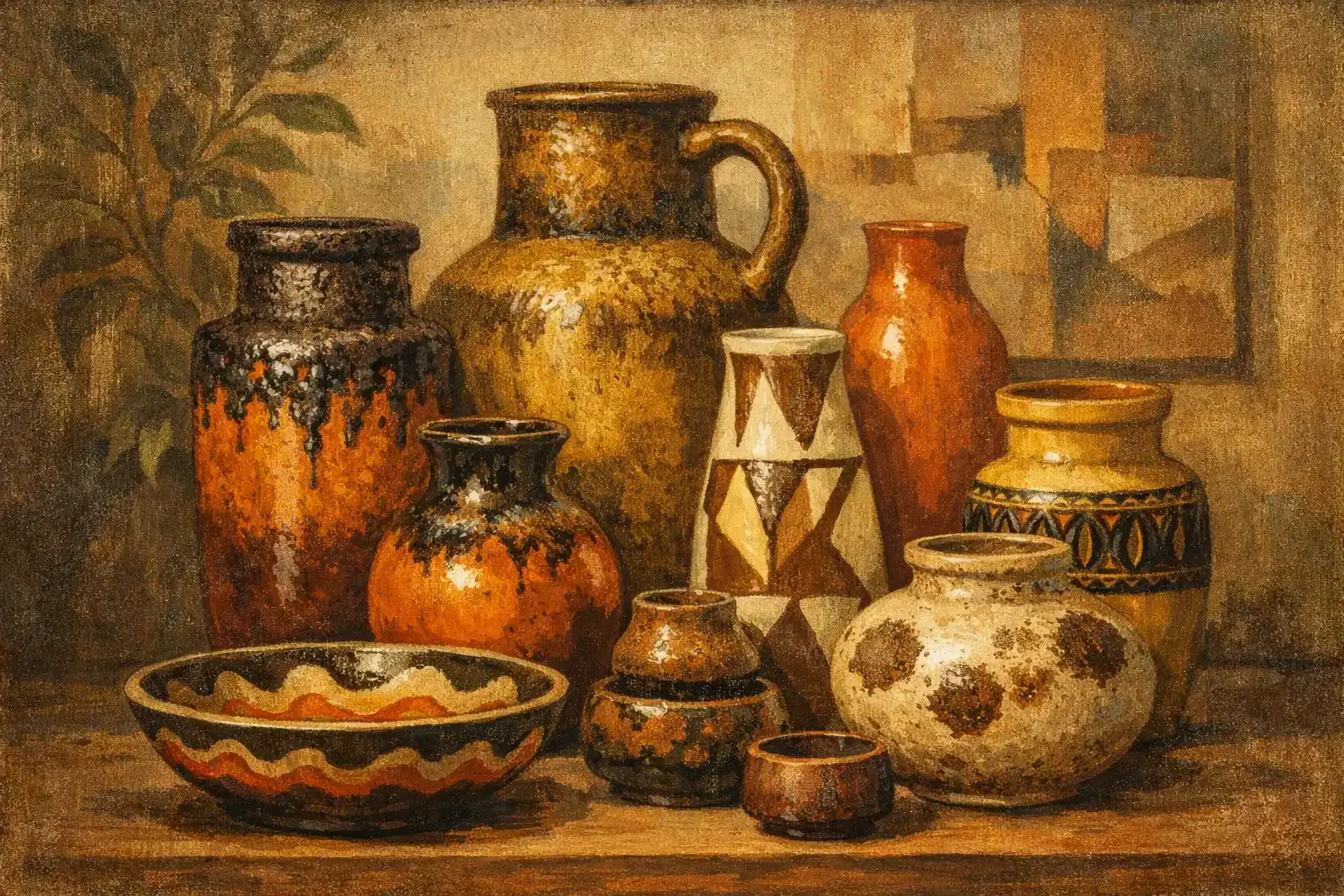
The name Fat Lava is useful, but it is not a formal historic category applied by every maker. It describes heavily textured, often volcanic-looking glazes: bubbled, crusted, foaming or dramatically pooled across a vessel. These finishes might be glossy, matt, monochrome or brilliantly coloured. A piece with a red-orange lava glaze is the image many people picture first, but the category is much wider than that.
What makes these objects compelling is their refusal to be background decoration. Handles twist and loop, necks rise sharply, bodies taper, swell or sit low and substantial. Even factory-produced pieces carry a sense of experiment because the glaze process gives each example subtle variation. That mixture of repeatable design and individual surface character is a large part of the charm.
The best examples also hold their own beside other periods. They work with teak and rosewood mid-century furniture, certainly, but they can look equally convincing against Georgian pine, industrial metal or contemporary plaster walls. Rather than recreating a 1960s sitting room, use them to introduce a considered note of colour, shape and history.
Recognising quality in German pottery
A desirable piece is not defined solely by a familiar label or a dramatic glaze. Condition, proportion and visual conviction matter just as much. Some of the most decorative pieces are from makers whose names are less widely recognised, while a famous factory mark does not automatically make an ordinary shape exceptional.
Factories including Scheurich, Bay Keramik, Dümler & Breiden, Ruscha, Carstens and Jasba made a great variety of forms. Marks on the underside can offer useful clues, often showing a mould number, a form number, a décor code, the factory name, or simply “W. Germany”. Numbers can help identify the shape, but they should be read as part of the picture rather than treated as a guarantee of date or rarity.
Look first at the form. Is the vase handsome from every angle? Does the handle feel integral to the design? Is there a satisfying balance between the neck and body? Strong German ceramics tend to have a deliberate silhouette, whether it is a tall floor vase with a narrow opening or a small, compact jug with a broad, tactile handle.
Then study the glaze. A good glaze has intention and energy, not merely colour. It may pool in recesses, catch on raised decoration or create a lively contrast between a dark ground and a brighter top layer. On Fat Lava work, unevenness is often precisely the point. The question is whether the texture feels expressive rather than accidental.
There is also a difference between age and wear. Fine crazing can be expected on some glazed ceramics and may add character, but it should be distinguished from a crack running through the body. Tiny glaze pops, kiln marks and minor irregularities are part of the making process. A large chip to the rim, a repaired handle or a poorly concealed break will affect both value and practical use.
Marks, labels and the limits of certainty
Paper labels are appealing because they preserve a direct link to the maker, but they are fragile and often lost. Their absence is not necessarily a concern. Likewise, an impressed base mark can be faint, partly glazed over or absent from a particular production run.
Be cautious of overly confident dating based on one online image or a single number. Designs were sometimes made over several years, and similar forms were produced by different factories. When buying, the most useful description brings together the known maker information, approximate period, dimensions and a clear account of condition. That is the level of detail that allows a piece to be appreciated honestly.
Choosing German pottery for your home
Start with the setting rather than the urge to collect everything at once. A large floor vase needs breathing room beside a fireplace, chair or sideboard. It is a sculptural object in its own right, even when empty. A smaller vessel is often most effective in a group of two or three, where differing heights and profiles create rhythm without becoming cluttered.
For an interior built around neutral walls and natural materials, a vivid Scheurich or Carstens vase can supply the colour that a room needs. Orange, mustard, cobalt and deep brown were all used with assurance, and their slightly earthy quality is less harsh than a flat modern accent colour. In more eclectic rooms, a textured black, cream or moss-green piece may provide contrast without competing with patterned textiles or artwork.
Scale is the usual stumbling block. Small vases are easy to place but can disappear on a wide console table. Conversely, an ambitious 40-centimetre floor vase may overwhelm a narrow hall. Measure the available surface or floor area, then consider the object’s visual weight as well as its height. A broad, dark vessel will read larger than a slender pale one of the same measurement.
Flowers are optional. Many West German vases have narrow openings better suited to a few stems, dried seed heads or a simple branch than a generous bouquet. Others are most successful left empty, allowing the form and glaze to do the work. Treating every vase as a functional flower holder can miss the point of a particularly sculptural example.
Building a collection with a discerning eye
Collections become more personal when there is a thread running through them. You might focus on a particular factory, a palette of brown and cream, unusual handles, or the contrast between lava-glazed and smooth modernist forms. A clear preference is more rewarding than chasing every label.
Rarity has its place, especially for collectors, but decorative impact should not be dismissed. Some comparatively common designs are superbly made and instantly recognisable in a room. Equally, an unusual object can be difficult to live with if its proportions or colours do not appeal to you. Buy the piece you will be pleased to see every day.
At MN Interior Antiques, the most persuasive ceramics are selected for that combination of authenticity and presence. Good curation considers the object beyond its maker: its surface, condition, scale and capacity to sit naturally among antique furniture, mid-century design and personal collections. A vase should have a story, but it should also earn its place in the room.
When comparing examples, ask for dimensions and inspect photographs of the rim, base, handles and interior where possible. Interior staining can be common in vases that have held water, though it is worth understanding its extent. If you intend to use a piece with fresh flowers, check that it is sound and watertight rather than assuming an older vase is suitable for regular use.
Caring for West German ceramics
Most decorative German pottery asks for very little. Dust with a soft, dry cloth or use a barely damp cloth for light surface dirt, then dry it promptly. Avoid abrasive pads, strong cleaning products and prolonged soaking, particularly around unglazed bases or old labels.
Display matters as much as cleaning. Keep ceramics away from precarious shelf edges, where a sleeve or a passing bag can catch a handle. Use felt pads beneath heavier vessels if they sit on polished wood, and do not stack them. Temperature extremes are unkind to pottery, so a treasured piece is better kept away from a cold conservatory in winter or direct, intense heat.
If you notice a crack, discontinue use with water and seek specialist advice before attempting any repair. Amateur adhesive repairs often stain, fail over time and reduce future collectability. Honest condition is always preferable to an invisible promise that does not hold up under close inspection.
The pleasure of German pottery is that it does not need a museum setting to feel special. Give one confident piece a little space, let its glaze catch the changing light, and it will bring the room a layer of character that new decoration rarely manages.