A single hand-thrown vase can disappear on a crowded shelf, while three modest pieces arranged with care can transform an entire room. The best vintage ceramics display ideas are less about filling every available surface and more about giving shape, glaze and history the space to register. Whether you collect studio pottery, slipware, majolica or bold West German Fat Lava, the aim is to make each object feel discovered rather than merely stored.
Ceramics bring an unusual kind of warmth to an interior. Their surfaces catch changing light, their irregularities reward a closer look, and their signs of age often add to their appeal. A small glaze frit, a potter’s mark or the softened wear around a handle can say more than a perfectly uniform decorative accessory ever could.
Start with the character of the collection
Before choosing a shelf or sideboard, look closely at what you own. A collection of 1960s and 1970s West German pottery has a very different visual language from English creamware or delicate Art Deco porcelain. Trying to make every period look identical can drain the arrangement of its interest.
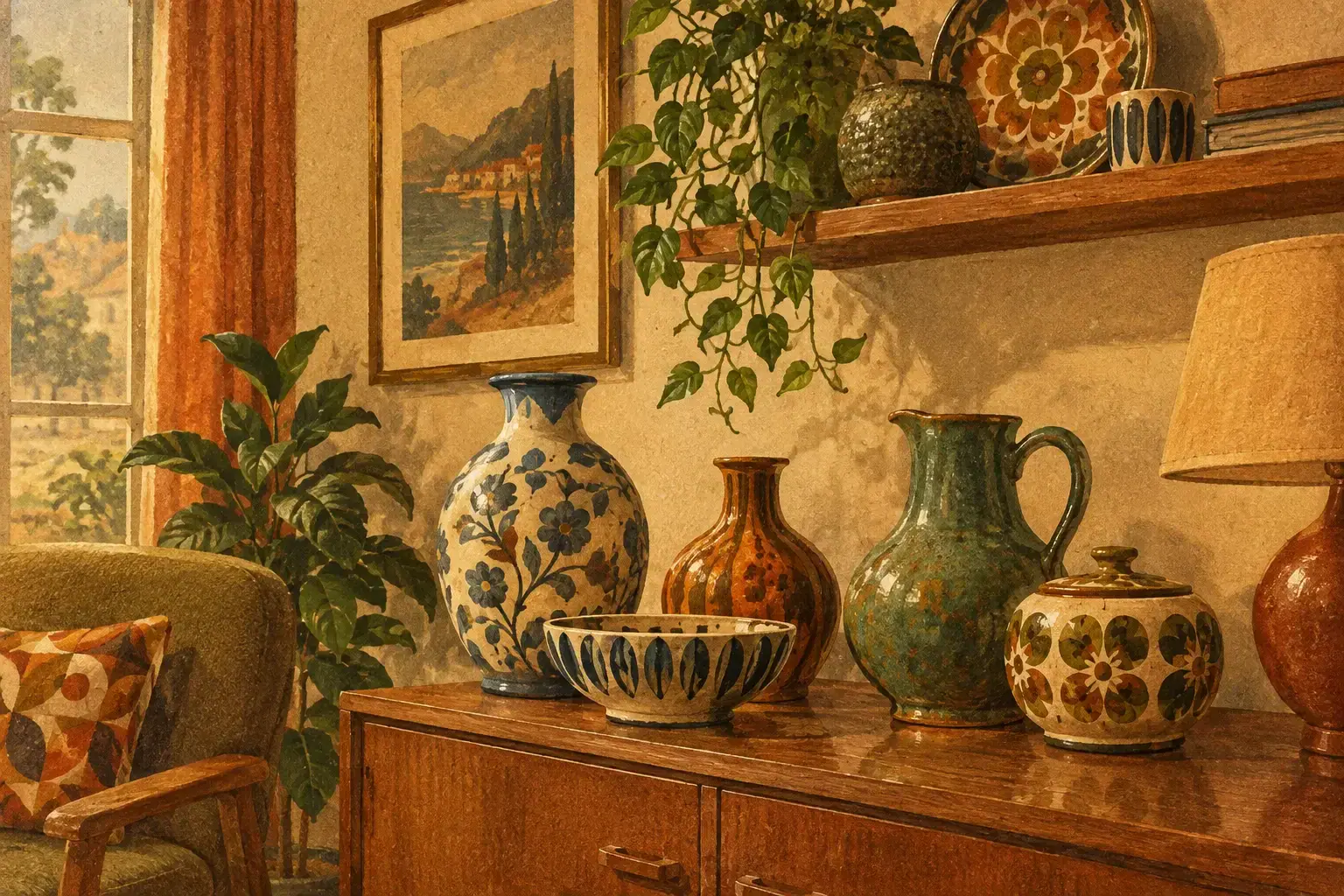
Group pieces first by a shared thread: colour, era, maker, material or form. Several brown, ochre and moss-green vases may sit beautifully together even if their makers differ. Equally, a grouping of varied white and cream vessels can feel striking when their silhouettes range from a squat teapot to a tall, narrow bottle vase.
This is also the point at which editing matters. Not every good piece belongs on display at once. Rotating a collection seasonally protects fragile objects from dust and sunlight, while allowing familiar rooms to feel newly composed. The most effective displays tend to have breathing room around the objects, not because they are sparse, but because every piece has earned its place.
Vintage ceramics display ideas for shelves
Open shelving is an obvious home for pottery, but it can quickly look like a shop stockroom if each shelf is packed edge to edge. Build the display as you would a small landscape. Start with one taller anchor piece, then introduce lower forms around it, allowing a little overlap without concealing the most distinctive details.
A useful approach is to vary height, width and texture within a restrained palette. A tall volcanic-glaze floor vase might stand beside a low, rounded vessel and a smaller handled jug. The contrast gives the eye somewhere to travel. If all pieces are a similar size, add a stack of old art books or a framed print behind the ceramics to introduce levels.
On deeper shelves, do not be afraid to place one or two objects slightly forward. This gives an arrangement depth, particularly with sculptural forms. However, avoid creating a tightly packed front row with hidden pieces behind it. A ceramic collection should be visible enough to enjoy, not a puzzle to retrieve.
Natural timber shelving is especially forgiving with earthy pottery, while painted shelves can heighten a more graphic collection. Deep tobacco, muted petrol blue and chalky olive provide a handsome backdrop for mustard, russet and cream glazes. Bright white has its place, particularly for dark stoneware or colourful mid-century forms, but it can make pale ceramics appear lost unless there is strong contrast elsewhere.
Use a cabinet as a quiet frame
A glazed cabinet suits smaller, more fragile pieces, including figurines, lustreware and hand-painted cups. It also works well when the collection benefits from being seen as a whole rather than individually scattered around a room. Arrange with the same attention to height, leaving gaps between clusters so reflections do not make the interior feel busy.
Lighting is worth considering here. Soft, indirect illumination helps reveal texture and colour, but strong heat or direct sun can be unkind to old glazes and painted decoration. Keep valuable pieces away from radiators and windowsills where temperature changes are greatest.
Make a sideboard display feel collected, not staged
A sideboard, chest of drawers or antique console gives ceramics a more flexible setting than a fixed shelf. Think of it as a temporary still life that can change as pieces come and go. Begin with a central visual weight – perhaps a substantial vase, a pair of table lamps or a framed artwork – then balance it with ceramics rather than arranging everything in a straight line.
Odd-numbered groupings often feel relaxed, but symmetry can be equally convincing where the objects themselves are irregular. Two similar candlesticks flanking a large studio bowl make a confident arrangement, especially on a mid-century teak sideboard. In a more traditional room, a pair of blue-and-white jars can bring order to a mantel or chest without making it feel formal.
Add only one or two supporting materials. A small framed landscape, a weathered brass box or a stack of books can create context, but too many accessories compete with the pottery. Ceramics already carry colour, pattern and texture. They rarely need much help.
Let one exceptional piece stand alone
Collectors often feel obliged to display objects in groups. Yet a singular piece can have far greater impact on its own. This is particularly true of unusual vessel forms, pieces with a strong maker’s mark, or pottery with dramatic lava, volcanic or drip glazes.
Place a standout vase where its outline can be seen clearly: at the end of a mantel, on a plinth, or on a low table against a plain wall. Leave enough space for its profile to read from across the room. A single sculptural ceramic can do the work of a painting, particularly when it catches late afternoon light.
There is a practical advantage, too. A solitary piece is less likely to be knocked when dusting or when a room is in use. For households with children, pets or busy entertaining spaces, reserve the most precious and unstable ceramics for higher, secure positions and display sturdier pieces at table height.
Use the dining table without making it precious
Ceramics belong in lived-in rooms, and the dining table is an excellent place to let them work harder. A generous bowl can hold pears, walnuts or seasonal branches. A vintage jug can become a flower vessel. These uses show the object as part of daily life, rather than something kept behind glass.
The trade-off is care. Avoid leaving water in unlined vintage vessels for long periods, particularly if you are unsure whether the glaze has fine cracks. Use a discreet glass insert for fresh flowers, and keep valuable pottery away from the most energetic part of the table during meals. A well-used vintage bowl should acquire presence, not unnecessary damage.
For a table display, choose a low arrangement that allows conversation across it. One broad bowl, a short vase and a pair of candleholders is usually sufficient. Tall collections of vases are better suited to a sideboard or hearth where they will not interrupt the view.
Create dialogue between eras
Vintage pottery need not be confined to a period-perfect room. In fact, its character often becomes clearer when paired with a contemporary sofa, a clean-lined kitchen or a restrained architectural interior. A fat, richly glazed 1970s vase can soften the precision of modern joinery. A delicate 1930s bowl can add humanity to a minimalist bedroom.
The key is to repeat something subtle. This might be the warm timber of a mid-century cabinet echoed in the brown of a stoneware glaze, or the curve of a ceramic lamp base repeated in a modern chair. A room does not need matching objects. It needs relationships between them.
For those building vintage interiors in Hertfordshire homes, this approach can be especially useful in newer properties where original architectural detail is limited. A carefully chosen antique chest, a vintage lamp and a small group of authentic ceramics can establish a sense of depth without turning the room into a pastiche.
Show provenance where it adds meaning
If a ceramic has an interesting maker, date or origin, a discreet label in a cabinet can be worthwhile, particularly for a serious collection. Elsewhere, let the object speak for itself. The maker’s mark underneath, the weight in the hand and the quality of the glaze are often more satisfying than a visible explanation.
When buying, prioritise condition alongside decorative appeal. Honest age-related wear is part of an antique ceramic’s story, but hairline cracks, restoration and chips should be understood before a piece is brought home. A restored bowl may still be a beautiful display object; it simply belongs in a lower-risk position than an untouched example.
At MN Interior Antiques, the most memorable ceramic pieces are rarely the loudest. They are the ones with conviction: an unusual silhouette, a beautifully judged glaze, or the unmistakable evidence of a maker’s hand. Give such objects room, place them where you will genuinely see them, and let the collection evolve at the pace of your home.