A well-chosen antique clock does more than mark the hour. It gives a room rhythm, scale and a sense of continuity: the soft tick in a quiet hall, a painted dial catching the afternoon light, or the warm patina of a mahogany case beside contemporary furniture. This guide to buying antique clocks is designed to help you recognise what you are seeing, ask sensible questions and choose a piece you will enjoy living with.
The best purchase is not always the oldest clock, the rarest name or the most elaborate case. It is the clock whose design, condition and mechanism feel right for your home, budget and appetite for ownership.
Start with the clock type and the room
Antique clocks were made for distinct settings, and their original purpose still shapes how they work in an interior. A longcase clock, often called a grandfather clock, has architectural presence and needs both height and visual breathing room. It can be a remarkable anchor in a hallway, dining room or tall sitting room, but may overwhelm a compact space.
Bracket clocks were intended for a wall bracket or mantelpiece and often have handsome brass details, domed tops and striking movements. They suit period interiors beautifully, though their sound deserves consideration. A striking clock in a bedroom or open-plan living space may be charming for some and intrusive for others.
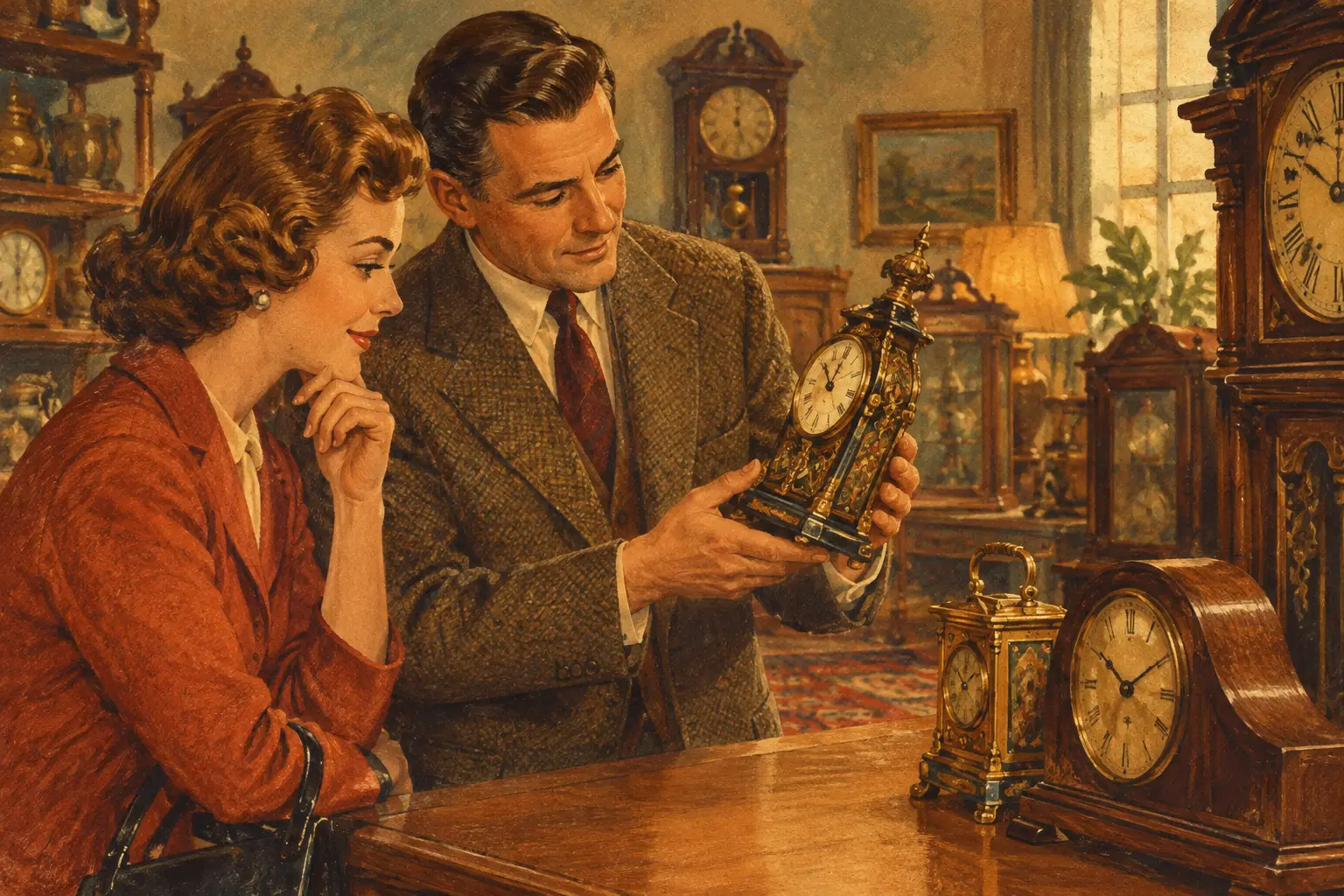
Mantel clocks are usually the easiest route into collecting. French gilt-metal and marble examples bring ornament and formality; Victorian slate clocks offer weight and drama; an Arts and Crafts or early twentieth-century oak clock can feel quieter and more architectural. For a desk, bedside table or small shelf, consider a carriage clock, travel clock or modest timepiece in a simple wooden case.
Choose the clock as you would a piece of antique furniture: by proportion first. Measure the intended spot, including the wall height and depth of any mantel. A clock that appears restrained in a dealer’s setting can feel unexpectedly substantial once it is in place.
A guide to buying antique clocks by movement
The movement is the clock’s working heart. You do not need to become a horologist before making a purchase, but a basic understanding will make descriptions and condition reports far clearer.
A mechanical clock is powered by either weights or springs. Longcase clocks commonly use weights, while many mantel and bracket clocks use springs wound with a key. An eight-day movement usually requires winding once a week. A thirty-hour longcase movement generally needs daily winding, which offers a pleasing ritual but is less convenient for some households.
Clocks may be time-only, or they may strike the hours on a bell, gong or set of rods. Some sound the half-hour as well. More complicated examples may include a calendar, moonphase, seconds dial, alarm, music mechanism or repeat function. Each feature adds interest, but also adds complexity and potential maintenance.
Quartz conversions deserve particular attention. A battery-powered movement may be entirely practical in a decorative case, especially if a clock is being bought principally for appearance. However, a conversion normally lowers collector value and removes much of the appeal of owning an antique clock. It should always be described plainly. If authenticity and long-term interest matter to you, seek an intact mechanical movement.
Ask whether the clock is currently running and, if possible, whether it has been tested over a reasonable period. “Working” can mean it ticked briefly during photography, rather than that it keeps time reliably for a week. A clock may also run but strike incorrectly, stop intermittently or need careful levelling. These are not automatic reasons to walk away, but they should be reflected in the price and your expectations.
Read the case, dial and details
A clock’s case tells you as much about its decorative value as its dial tells you about its maker. Look at timber colour, veneer, inlay, mouldings, handles, finials and feet as a whole. The best cases retain an honest surface: small marks, gentle fading and age-darkened brass are often part of the object’s character.
Be cautious of an aggressively stripped, heavily varnished or uniformly coloured case. Restoration can be necessary and skilful, particularly where a clock has suffered damp or neglect, but over-restoration may flatten its history. Replaced veneers, later mouldings and repaired cracks are common in clocks that have survived for two centuries or more. What matters is whether the work is stable, proportionate and clearly disclosed.
The dial merits close attention. Painted dials often show fine crazing, small chips or faded numerals, especially on nineteenth-century clocks. These signs can be attractive if they are not excessive. A completely repainted dial may look crisp but can reduce originality, unless it is a documented specialist restoration. On brass dials, examine the engraved decoration, chapter ring and spandrels for consistency and wear.
Hands are frequently replaced over a clock’s life. A sympathetic old replacement is different from a poorly fitted modern hand that obscures the dial or does not match the period. Likewise, replacement keys, pendulums and finials are not necessarily a problem, but original components are always desirable where condition and price are otherwise comparable.
Provenance, makers and the value of names
A signed dial can be exciting, but a famous name alone does not guarantee a great buy. Some clocks carry retailer names rather than the actual maker’s name. Others have later inscriptions, marriage dedications or presentation plaques that add personal history without necessarily adding market value.
Provenance is strongest when it is specific. A receipt from a respected dealer, an old auction catalogue, a written family history, photographs of the clock in its former house or details of a documented restoration all help build a credible story. Vague claims such as “from a country house” should be treated as atmosphere rather than evidence unless supporting information is available.
For a first purchase, it is often wiser to buy quality and condition over a fashionable maker. A well-proportioned Victorian mantel clock with an original dial, sound case and recently serviced movement can bring more lasting pleasure than a more ambitious but tired example carrying a celebrated name.
Condition is not just cosmetic
Clock condition is inseparable from cost. A beautiful case with a tired movement may require specialist attention before it can be used with confidence. Servicing can involve dismantling, cleaning, correcting wear in pivot holes, replacing damaged components and regulating the clock once reassembled. This is skilled work, and the expense should be anticipated rather than treated as an unwelcome surprise.
Before buying, establish whether the movement has been serviced, when this was done and by whom. Ask whether it comes with its pendulum, weights, winding key and any other relevant fittings. For a longcase clock, confirm that the seatboard, hood, trunk door and base appear to belong together. Composite clocks, assembled from period parts, exist and should be priced and described accordingly.
A clock does not need to be pristine to be desirable. In fact, untouched surfaces and minor evidence of use can be more appealing than perfection. The distinction is between honest age and faults that compromise structure, function or originality.
Buy from clear descriptions and ask direct questions
When buying online, detailed photographs and transparent condition notes are essential. Images should show the front, sides, back, movement where possible, dial close-ups and any notable repairs or marks. Dimensions should include height, width and depth, not just the most flattering frontal measurement.
If something is unclear, ask. Useful questions include whether the clock runs and strikes, whether it has been serviced, which elements are known replacements, and whether there is evidence of past woodworm, damp or structural repair. It is also sensible to ask how a delicate clock will be packed and whether a large example requires specialist delivery.
For buyers near Stevenage and across Hertfordshire, seeing a clock in person can be particularly valuable. You can assess scale, listen to its strike and look at the surface without relying on a screen. At MN Interior Antiques, the most rewarding objects are presented with the practical detail needed to appreciate both their decorative role and their history.
Plan for ownership, not just purchase
Mechanical clocks ask for a little attention. They should stand level on a stable surface, away from persistent damp, strong heat and direct sunlight. Winding should be done gently, using the correct key, without forcing a mechanism at the end of its travel. Longcase clocks need careful installation and should not be moved with pendulum or weights in place.
Accuracy varies. An antique clock is not a modern electronic device, and a few minutes’ variation over a week can be perfectly acceptable depending on its age and movement. If precise timekeeping is your priority, a simpler, recently serviced clock may be a better choice than a complicated statement piece.
Allow the clock to become part of the household slowly. Learn its winding day, its particular chime and the quality of its presence at different times of day. The right antique clock is not merely an accessory for a mantel or hall table. It is a small working piece of history, chosen for the way it makes a home feel more personal with every passing hour.