A salvaged Victorian door with its old brass letterplate intact can give a plain hallway more presence than an entire catalogue of new fittings. That is the appeal behind the best architectural salvage ideas: they introduce material honesty, useful history and a little welcome irregularity into rooms that might otherwise feel too finished. A worn threshold, a cast-iron vent or a single carved bracket can become the detail that makes a home feel personal rather than merely decorated.
Architectural salvage is not about making every room look like a period set. The most convincing interiors balance old materials with the way people live now. A reclaimed piece should either work hard, add visual structure or bring a particular quality of workmanship that would be difficult to find in modern production.
Best Architectural Salvage Ideas That Earn Their Place
Make a reclaimed door the centrepiece
Panelled internal doors are among the most adaptable finds. A stripped pine door can suit a country kitchen or a relaxed bedroom, while a painted Victorian four-panel door brings height and rhythm to a hallway. Original layers of paint are often part of the charm, but check their condition before sanding, particularly in older finishes.
For a practical installation, measure the opening carefully and expect some adjustment. Old doors were made before standardised sizing, so a joiner may need to alter the edges, repair a split or build up a frame. If the door is too handsome to cut down, use it as a sliding door, a cupboard front or a freestanding screen instead. The latter works especially well in larger bedrooms where a dressing area needs gentle separation.
Give fireplaces a second life
A reclaimed mantel, tiled insert or cast-iron fire surround can anchor a sitting room even where no working fireplace remains. It provides a natural focal point for art, a mirror, ceramics or a pair of lamps, without requiring a complete period restoration.
The key is proportion. A grand carved surround can overwhelm a compact terrace, whereas a simple timber mantel or modest Edwardian insert can add just enough architectural weight. If you are fitting a fire surround around a functioning stove or fire, obtain proper advice on clearances, heat resistance and installation. Decorative pieces are forgiving; heat-producing appliances are not.
Use cast iron where modern rooms need definition
Cast-iron air bricks, floor grilles, boot scrapers and radiator covers have a graphic quality that works beautifully against limewashed walls, pale timber and simple joinery. A restored floor grille set into a timber floor is a small detail, but one that rewards a closer look. In a kitchen, a cast-iron bracket beneath an open shelf adds substance without making the room feel overly rustic.
Patina is desirable, but corrosion needs judgement. Surface rust can be stabilised and retained for character; deep corrosion that weakens a piece is a different matter. Ask whether an item is decorative or suitable for daily use, especially with grilles, railings and hardware that will bear weight.
Turn stone fragments into garden punctuation
Old stone coping, paving, troughs and finials lend a garden the feeling that it has evolved over time. A weathered stone trough planted with herbs near a back door is both useful and sculptural. Reclaimed edging can give a gravel path definition, while a single finial placed among looser planting offers a pleasing point of contrast.
Be realistic about weight and weathering. Stone needs a firm base, and anything standing tall must be safely secured. Frost-resistant pieces are the sensible choice for exposed sites, though some surface wear is part of the material’s appeal. Avoid overfilling a small garden with fragments. One substantial trough often has more impact than several minor ornaments.
Choose reclaimed flooring selectively
Reclaimed boards, parquet and quarry tiles can transform the mood of a room, but they demand more planning than their informal appearance suggests. Wide pine boards bring warmth to bedrooms and studies. Victorian quarry tiles suit porches, boot rooms and entrance halls, where their hard-wearing character makes practical sense.
Consistency is the challenge. Reclaimed flooring may vary in thickness, moisture content and finish, so it should be assessed before installation rather than treated as an easy cosmetic update. Parquet can be particularly rewarding, but it needs a sound, level subfloor and a patient installer. Where a full reclaimed floor is beyond budget or impractical, use antique tiles for a hearth, porch threshold or small utility area instead.
Let old hardware do the quiet work
Knobs, escutcheons, finger plates, casement stays and latches may be small, yet they are among the quickest ways to remove the generic feel from modern joinery. A set of aged brass handles on a plain painted cupboard gives it a sense of permanence. Blacksmith-made ironwork can bring a useful degree of texture to a simple pantry or garden gate.
Look for pairs and sets where possible, and check the mechanism as well as the appearance. A beautiful rim lock missing its key may still work as a decorative addition, but it is not the right choice for a door that needs daily security. Mixing periods can work, provided the finishes relate. Polished brass, aged brass and black iron can happily coexist when the room is otherwise restrained.
Architectural Salvage Ideas for Everyday Rooms
Build a kitchen with salvaged character
Kitchens benefit from salvage when it is used as an accent rather than a theme. An old glazed cupboard door can become a pantry front, reclaimed shelf brackets can support everyday crockery, and a worn timber worktable can offer a useful preparation surface. The contrast between clean modern cabinetry and one piece with age is usually more successful than trying to recreate an entire Victorian scullery.
Consider hygiene and maintenance before committing. Timber needs sealing if it will face splashes, and antique drawers may be better used away from heavy cooking zones. Salvaged elements should complement efficient storage, good lighting and durable work surfaces, not compromise them.
Create a hallway with a sense of arrival
Hallways are ideal for architectural salvage because they are transitional spaces that benefit from strong first impressions. A reclaimed coat rack, a narrow church pew, an old mirror or a run of encaustic tiles can establish character from the threshold. If space is tight, choose one defining item and keep the rest of the scheme clear.
A vintage light fitting can complete the effect, but it must be inspected and rewired by a qualified electrician where necessary. For buyers seeking vintage lighting in Hertfordshire, the most useful question is not simply whether a fitting looks right, but whether its scale, light output and wiring suit the space it will serve.
Use fragments as objects, not substitutes
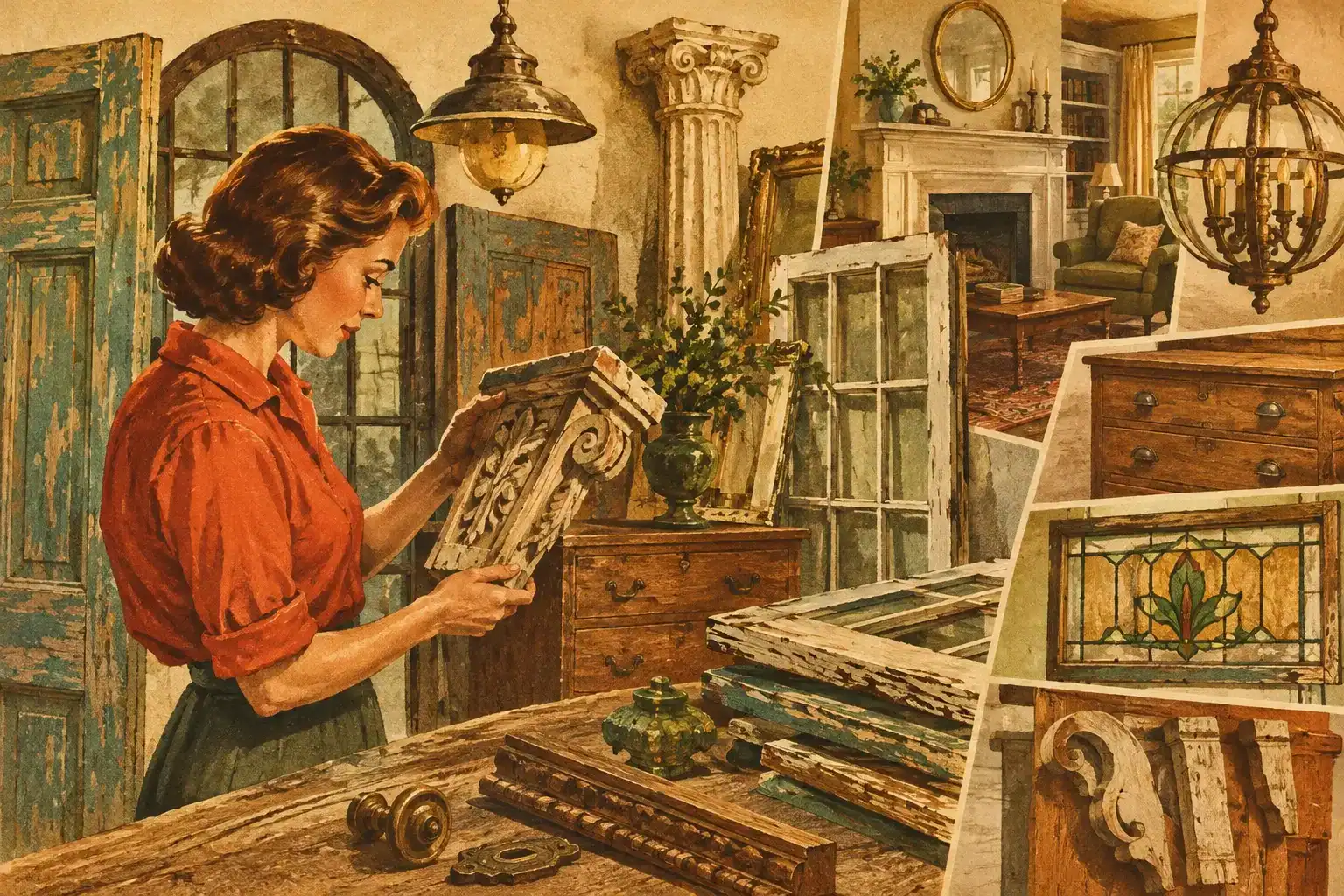
Not every salvaged find needs to be rebuilt into its original purpose. A carved corbel can sit on a mantel as a sculptural object. An old section of railings can be mounted as wall art. A terracotta roof finial might stand on a plinth in a conservatory or near a garden wall.
This approach is especially useful for smaller, incomplete pieces whose craftsmanship remains compelling. It also avoids forcing an object into a role it cannot safely fulfil. A fragment with a story is more interesting when displayed honestly than when awkwardly transformed into furniture.
What to Check Before You Buy
The romance of salvage should never replace a practical inspection. Examine timber for active woodworm, significant rot and unstable joins. On metal, distinguish attractive age from structural damage. With tiles and stone, allow for chips and variation, but make sure there are enough usable pieces for the intended area.
Provenance matters too. Ask what the item is, where it came from if known, and whether it has been altered or restored. A sympathetic repair is often a virtue: it keeps a useful piece in circulation. What matters is clarity about condition and suitability. At MN Interior Antiques, that balance between decorative character and honest presentation is central to selecting architectural salvage with a story to tell.
Finally, plan the route into the house before buying anything substantial. Measure doorways, stairwells and turning points, not just the intended wall or floor area. The right salvaged object should feel discovered, not difficult. Choose the piece that makes a room more liveable as well as more memorable, then allow its age and imperfections to do the rest.