A 1960s ceramic table lamp can give a room far more presence than a new one ever could. Its glaze, silhouette and gentle pool of light are part of the appeal, but vintage lamp safety must come before atmosphere. A lamp may have survived decades beautifully while its flex, plug or internal connections have not. The good news is that sympathetic electrical work can make a period piece suitable for everyday use without losing the details that made it worth choosing.
For anyone buying vintage lighting in Hertfordshire or further afield, the aim is not to make an old lamp look factory-new. It is to preserve its character while ensuring the working parts are appropriate for a modern British home.
Why vintage lamps need a closer look
A decorative object and an electrical appliance age in different ways. Brass develops a mellow patina, timber gains warmth and hand-thrown ceramic bases acquire the small irregularities collectors value. Rubber insulation, old cable and worn lamp holders, however, can become brittle or unreliable with time.
Many lamps have also been altered during their lives. A period base may have been rewired well twenty years ago, fitted with an unsuitable replacement holder, or converted from a continental fitting. None of these details automatically makes it unsafe. They simply mean the lamp should be assessed as the individual object it is, rather than judged by age alone.
The most useful distinction is between provenance and condition. An original fitting may be historically interesting, but originality is not always the right reason to retain an electrical component. The base, shade frame, switch design and finish can usually remain true to the piece while the hidden working elements are renewed.
Vintage lamp safety checks before purchase
Start with the visible basics. A trustworthy seller should be able to describe whether a lamp is sold as decorative only, in working order, or newly rewired. “It lights up” is not the same as a meaningful condition assessment. Ask when the wiring was replaced, whether the lamp has a UK plug, and whether any work was carried out by a qualified professional.
Inspect the flex, plug and switch
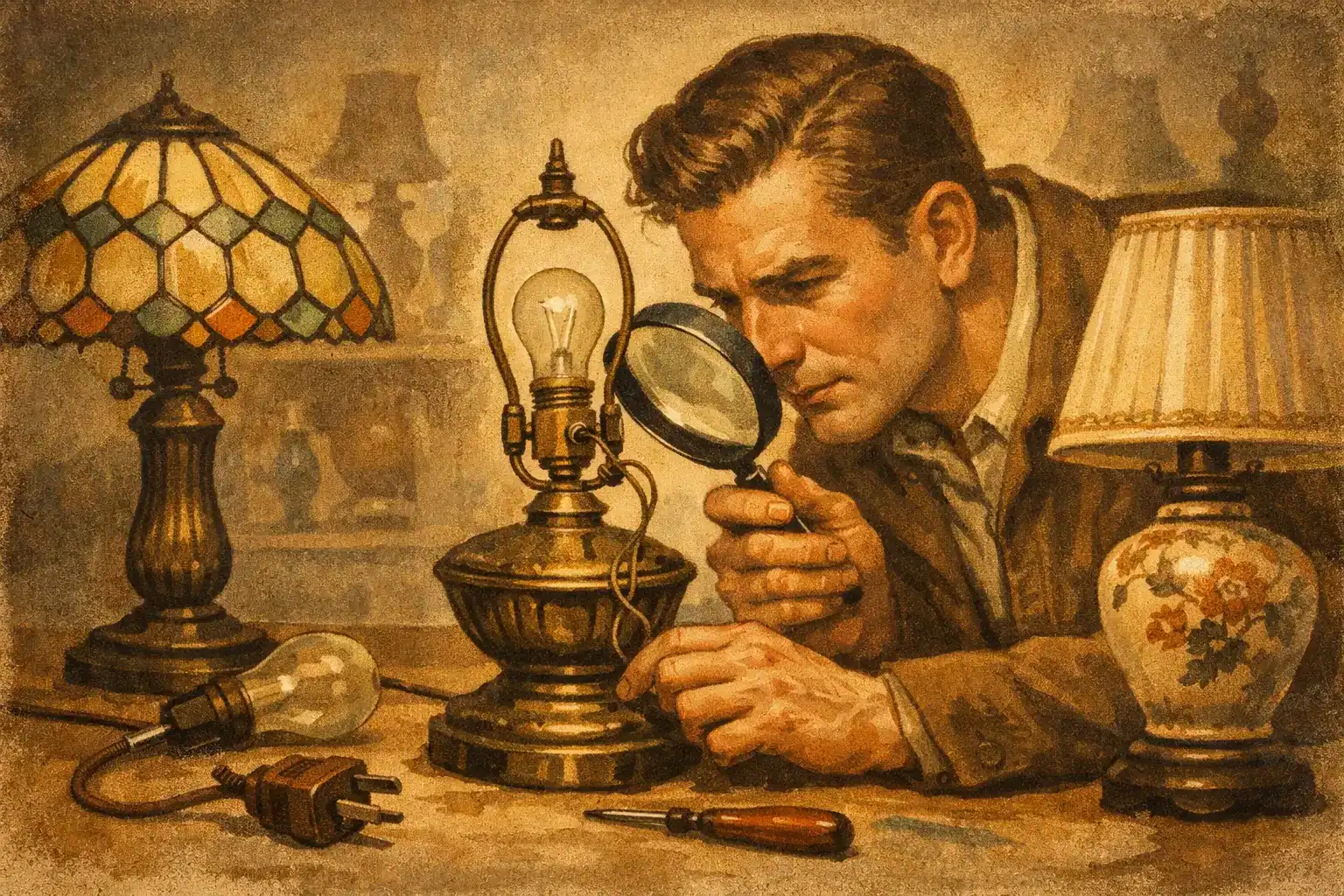
Look along the full length of the cable. Cracks, stiffness, fraying, flattened sections and taped repairs are all reasons to stop and seek advice before use. Older braided flex can be attractive and entirely suitable if it is modern, correctly specified replacement cable. Original fabric-covered cable may be best retained only where it is demonstrably sound and appropriate for use.
The plug should be a properly fitted British three-pin plug, with no damaged casing or loose pins. For a typical table lamp, a 3 amp fuse is commonly appropriate, though the correct fuse ultimately depends on the lamp and its fitted bulb. Never replace a fuse with a higher rating simply to prevent it blowing.
Switches deserve equal attention. A switch that becomes hot, crackles, flickers or works only when held at a certain angle should not be treated as an endearing quirk. Turn the lamp off, unplug it and have the fault investigated.
Check the lamp holder and shade clearance
The lamp holder should hold the bulb securely and sit firmly within the lamp. It must not wobble, show cracks or reveal exposed wiring. With metal lamps, earthing may be required unless the fitting is designed as double-insulated. This is one area where guessing is unwise: a competent electrician can identify the construction and wire it correctly.
Then fit the intended shade and consider the space around the bulb. A shade that sits too close can trap heat, scorch lining or distort fragile plastics. Delicate celluloid, parchment, silk and old painted shades can be particularly vulnerable. The bulb must also clear any decorative fringe, wiring or internal frame.
Look beneath the beauty
Turn the lamp over, with it unplugged, and inspect the base. The cable should enter through a proper grommet or strain relief, not a rough-edged hole that could cut through the insulation. A stable lamp needs an intact base plate or felt, particularly when the body is heavy pottery, marble or cast metal.
Consider where the cable emerges as well. A lead trapped beneath a foot, pulled taut across a side table or caught by a drawer is vulnerable to damage. These practical details matter as much in a compact flat as in a larger period house.
Rewiring without losing the lamp’s character
Rewiring is often the most responsible choice for a lamp that will be used regularly. Done thoughtfully, it is a conservation-minded repair, not a compromise. The external form remains intact while aged components that cannot be seen and should not be relied upon are replaced.
A qualified electrician or experienced lighting restorer can fit a suitable modern flex, lamp holder, switch and plug. The right choice of cable matters aesthetically as well as electrically: black, brown, gold, twisted or fabric-covered replacement flex can complement the era and finish rather than jar with it. A mid-century teak lamp, for example, may suit a restrained dark flex, while a more decorative brass or ceramic piece may call for a braided option.
Some lamps need more than a straightforward rewire. Imported pieces may require conversion to suit UK voltage and fittings. Antique gas or oil lamp conversions need a careful assessment of stability, heat and access to the bulb. A chandelier may require inspection of every arm, connection and ceiling fitting, not just a new ceiling rose.
Avoid improvised alterations. Adapter plugs, mismatched fittings and makeshift repairs can undermine an otherwise sound lamp. If a lamp requires work, factor that cost into the purchase. A well-made base with a strong decorative presence is often worth restoring properly, while a poorly constructed or unstable example may not justify extensive intervention.
Choose bulbs that protect the lamp and its shade
Modern LED bulbs are usually the sensible partner for vintage lighting. They use less energy and produce significantly less heat than traditional incandescent bulbs, helping to protect old shades, lamp holders and nearby finishes. Their lower wattage also reduces strain in many older-style table lamps, provided the fitting itself is in good order.
Pay attention to bulb shape, brightness and colour temperature. A large globe bulb may look striking but be too close to the shade. A small candle bulb may be the only practical option for a narrow ceramic or brass lamp. For a warm, lived-in effect in a sitting room or bedroom, many people prefer an LED around 2200K to 2700K rather than a cool white light.
Always observe the maximum wattage marked on the fitting or shade, where present. With an LED, the actual wattage is low, but its physical size and heat at the base still need consideration. Do not use a bulb that touches the shade, presses against a harp or leaves too little air around the holder.
Placement is part of safe use
A beautifully restored lamp can still become unsafe through poor placement. Keep it away from curtains, bedding, bookshelves crowded with paper, and areas where it might be knocked by children or pets. On a console or sideboard, make sure the lamp stands level and the cable can reach the socket without crossing a walkway.
Bathrooms, kitchens and damp utility spaces require particular caution. Ordinary table lamps are generally not designed for wet or humid zones, and lighting close to water is subject to specific requirements. Choose lighting intended for the location and ask an electrician if there is any uncertainty.
Extension leads should be a temporary convenience, not a permanent plan for a reading lamp. Avoid overloading multiway adapters, and never conceal a flex beneath a rug. If the lamp is placed in a room used only occasionally, unplug it between uses rather than leaving it energised indefinitely.
When to stop using a vintage lamp
Switch off and unplug the lamp immediately if you notice a burning smell, smoke, repeated fuse failure, tingling from a metal surface, buzzing, flickering or unusual heat around the plug, cable, switch or holder. Do not attempt to test it again to see whether the problem repeats. These are signs for professional inspection.
It is also sensible to have a lamp checked after a fall, a water spill or a period in storage in a damp loft, garage or shed. Damage can occur inside the base or along the cable even when the exterior appears largely unchanged.
For a cherished lamp, restoration is part of ownership. Much like waxing an antique chest or carefully displaying West German pottery, it allows the object to remain present in daily life without asking it to perform beyond its condition.
A vintage lamp should earn its place not only through its form, but through the confidence that comes with using it well. Choose a piece with a story to tell, give its electrical parts the attention they deserve, and let its character illuminate the room for years to come.