A beautiful dining chair has to earn its place. It must be comfortable through a long supper, practical enough for daily use, and handsome enough to hold a room together when the table is clear. The top Danish dining chairs do all three with uncommon assurance. Their appeal lies not in novelty, but in the intelligence of their construction: fine timber, carefully resolved proportions and details that reveal themselves slowly.
For a home furnished with vintage pieces, Danish dining chairs offer a particularly useful balance. They bring warmth to pared-back interiors, restraint to more decorative schemes, and a sense of genuine history that new reproductions rarely carry. The right set is not simply seating. It is a collection of small, functional sculptures shaped by some of the most thoughtful furniture makers of the twentieth century.
What makes Danish dining chairs so enduring?
The golden period of Danish furniture design, particularly from the late 1940s through the 1960s, was built on respect for materials and making. Designers worked closely with cabinetmakers, often refining a chair over several prototypes until the frame felt light in the hand, secure under weight and visually calm from every angle.
Teak and rosewood were widely used for their rich grain and ability to be finely shaped. Oak, beech and ash brought a lighter, more informal character. Across these woods, the best designs share a disciplined approach: gently tapered legs, curved rails that support the body, and joints that look considered rather than concealed. A chair may appear simple, but its elegance depends on dozens of exact decisions.
There is also a useful distinction between Danish design and a general mid-century look. Plenty of later chairs borrow the silhouette – a sloping back, slim legs, woven seat – without matching the quality of the original. Authentic examples tend to feel purposeful. Their proportions are measured, the timber is properly finished, and the frame has a satisfying solidity despite its apparent lightness.
Top Danish dining chairs to know
Hans J. Wegner Wishbone Chair, CH24
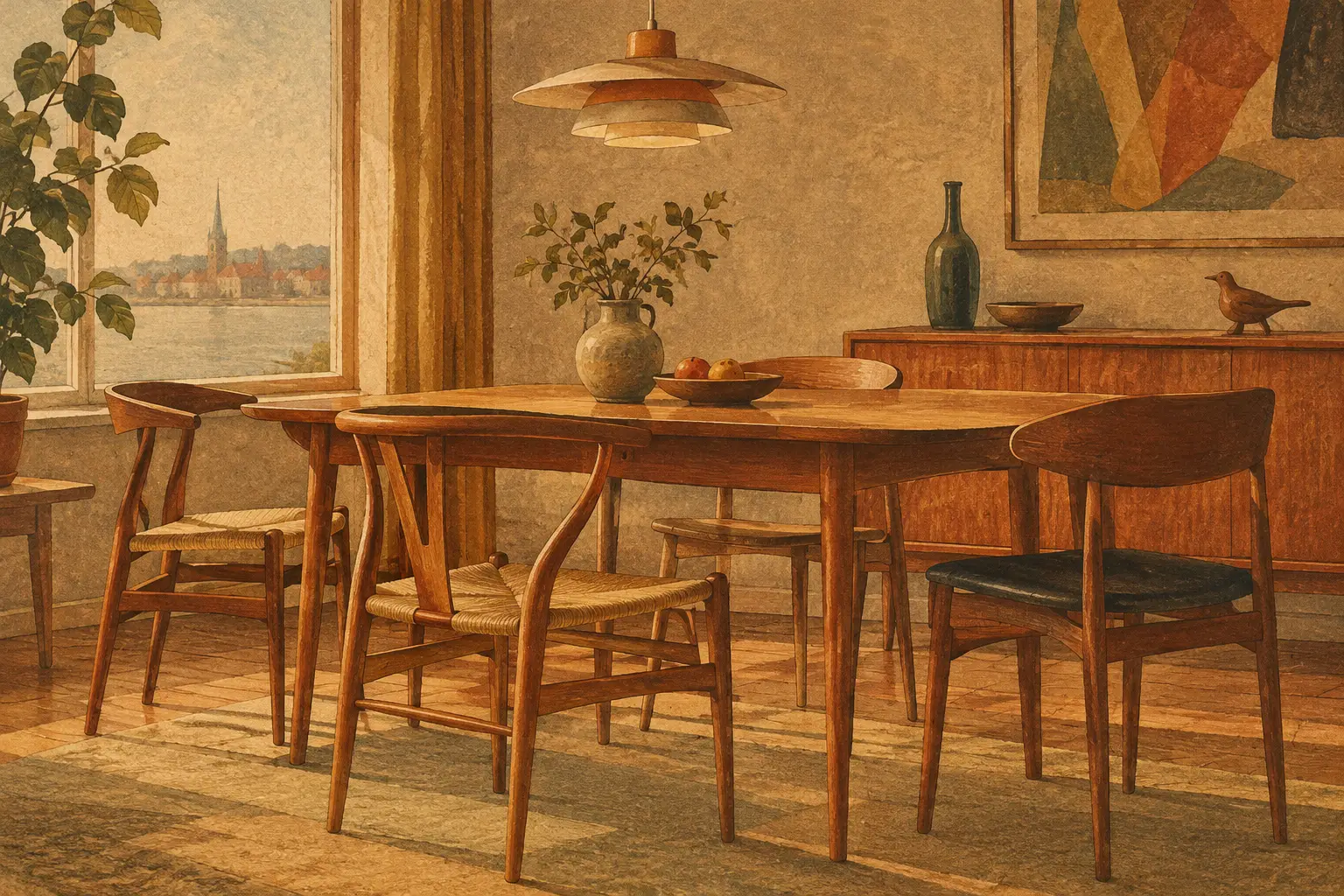
Wegner’s Wishbone Chair is among the most recognisable Danish chairs ever made, yet it remains popular for good reason. Its distinctive Y-shaped back supports a hand-woven paper cord seat, while the rounded frame gives it a softness missing from many angular mid-century designs.
It works especially well around a farmhouse table, a pale oak refectory table or a more contemporary dining setting that needs natural texture. Original examples and early production pieces are prized, but condition matters more than fashion. Paper cord can be re-woven, and this is often preferable to living with a sagging or broken seat, provided the work has been carried out carefully. Look closely at the top rail and arms for old repairs, as these are areas that receive regular pressure.
Børge Mogensen J39 and J77 chairs
Børge Mogensen designed furniture for ordinary domestic life, and his chairs have an appealing lack of ceremony. The J39, often called the People’s Chair, is a straightforward beech chair with a woven paper cord seat. It is modest, honest and remarkably adaptable. A group of J39s brings an easy Scandinavian character to a kitchen or breakfast room without making the setting feel overly designed.
The J77 has a more pronounced spindle back and a gently playful profile. It suits country houses, Victorian terraces and modern homes equally well because its roots are partly in traditional vernacular furniture. Neither chair offers the upholstered comfort of a Møller design, but both are practical choices for households that value a lighter, less formal look.
Niels Otto Møller Model 71, 75 and 78
For many collectors, Niels Otto Møller chairs represent the height of Danish dining-room refinement. Produced by J.L. Møllers Møbelfabrik, the Model 71, 75 and 78 are celebrated for their sculptural timber frames and beautifully integrated upholstered seats.
The Model 71 is known for its curved back rail and poised, narrow stance. Model 75 has a more enveloping form, with shaped uprights that give it a stronger architectural presence. Model 78 is slightly more generous and relaxed, making it a sensible choice where the dining table is used for lingering meals rather than occasional entertaining.
These chairs often appear in teak or rosewood with original wool, vinyl or leather upholstery. Original fabric gives a set real period character, but worn foam, threadbare cloth or split vinyl can make daily use difficult. Reupholstery is not automatically a negative. A well-restored set in a sympathetic wool or leather can be more useful and can preserve the chair for decades. The important consideration is whether the timber frame, joints and proportions remain intact.
Kai Kristiansen Model 42
Kai Kristiansen’s Model 42 chair is often nicknamed the Z Chair because of the angled, graphic line created by its frame. It has more visual energy than the quieter Møller forms, making it a strong choice for a dining room that needs a focal point without relying on excessive ornament.
Its design is also an excellent example of why photographs alone can mislead. The chair’s delicate rear legs and cantilevered back create a sense of lightness, but the joints must be checked carefully. A little movement in a vintage chair may be remedied by a skilled restorer; significant splitting, crude screws or poorly aligned repairs call for closer scrutiny. This is a chair worth buying from a dealer who understands condition rather than simply recognising a famous outline.
Erik Buch Model 49
Erik Buch’s Model 49 is a classic choice for those who prefer a more substantial, upholstered dining chair. Its tall curved back and sweeping timber supports offer comfort while retaining the slim profile associated with Danish modern furniture. In a set of six or eight, it creates immediate presence around a long teak table.
Because the upholstery forms such a large part of its appearance, these chairs offer scope for a considered update. Deep olive, tobacco leather, oatmeal wool or a nubby bouclé can all alter the mood while respecting the chair’s original shape. The trade-off is practical: pale fabric looks refined but asks more of a busy family dining room, while leather is forgiving and develops character with use.
How to choose the right set for your table
Before falling for a silhouette, take measurements. Dining chairs need enough space to be pulled back comfortably, and arms must clear the underside of the table if you are considering occasional carvers. A seat height of roughly 45 to 48 centimetres suits many tables, but vintage tables vary, especially those with deep aprons.
Think, too, about how your room is used. Paper cord and rush create texture and visual lightness, but upholstered seats are more comfortable for long dinners. Teak brings mellow warmth beside brick, linen and aged brass; oak feels fresher and is often easier to place with painted furniture. Rosewood has exceptional drama, though a full set can be visually powerful in a compact room.
Matching sets are satisfying, but they are not the only route. Four or six identical side chairs with a contrasting pair of carvers at either end can give a dining arrangement a collected quality. The key is to repeat something – timber tone, seat material or period – so the combination feels intentional. A room should feel assembled over time, not staged from a catalogue.
Authenticity and condition: what deserves attention
Labels, stamps and maker’s marks are valuable, particularly for chairs made by recognised workshops such as Carl Hansen & Søn, Fritz Hansen, Søborg Møbelfabrik and J.L. Møllers Møbelfabrik. Yet a missing label does not necessarily mean a chair is inauthentic. Labels are often lost during cleaning, restoration or reupholstery. Construction, dimensions, timber quality and provenance should all inform the judgement.
Check that a chair sits level, that joints are firm, and that the seat is properly supported. Small differences in timber colour are normal in vintage sets, especially where chairs have received uneven sunlight. Freshly stripped or heavily sanded surfaces deserve caution, as original edges and patina can be lost. Sensitive restoration should stabilise and preserve rather than erase the evidence of age.
At MN Interior Antiques, the enduring appeal of vintage furniture is not perfection in a factory-fresh sense. It is the meeting of good design, honest material and a life already lived. A carefully chosen Danish chair can make the daily act of sitting down to eat feel considered, comfortable and distinctly your own.