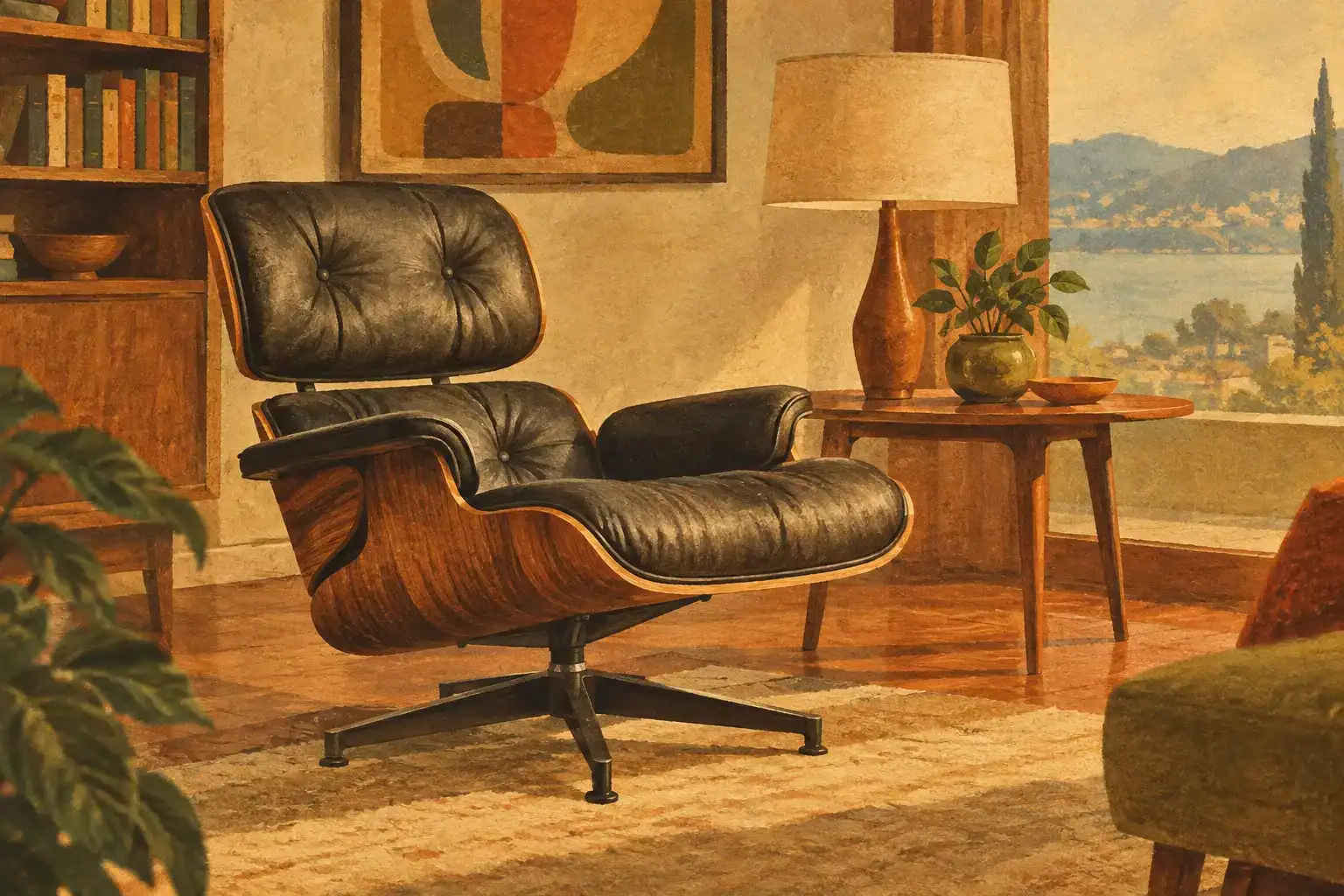
A good chair can make a room feel considered before anything else has been added. In this mid-century chair review, we look beyond the familiar silhouette of tapered legs and angled arms to consider what makes an original piece desirable, liveable and worth its place in a home.
Mid-century chairs remain popular because they solve two problems at once. They offer a clear design language – lightness, proportion and honest materials – while bringing the welcome irregularities of age that modern reproductions rarely achieve. Yet the label is used loosely. A chair can borrow a 1950s look without carrying the construction, history or comfort that give a genuine vintage example its appeal.
What Defines a Good Mid-century Chair?
The mid-century period broadly covers furniture made from the late 1940s through the 1960s, although individual designers and makers worked either side of those dates. British, Scandinavian, European and American furniture from this era has a shared interest in clean lines, practical forms and materials used with confidence. It is not one uniform style.
A British teak lounge chair may feel quietly architectural, with a sturdy frame and a restrained profile. A Danish example might use softly sculpted oak or beech, curved backs and exceptional joinery. Italian designs can be more expressive, pairing tubular metal, lacquered surfaces or adventurous upholstery with a more theatrical outline. Each can sit comfortably within a mid-century interior, but they should not be judged by precisely the same criteria.
The best chairs have visual balance from every angle. Look at the relationship between the seat, back, arms and legs. A well-designed frame appears light without seeming flimsy, and the timber grain, joints and transitions feel deliberate rather than merely decorative. This is where an original often has the advantage: it was made at a time when furniture makers expected a chair to be handled, moved and used for decades.
Mid-century Chair Review: Material, Make and Condition
Timber is often the first clue. Teak, oak, beech, elm and walnut all appear in period furniture, selected for their strength, grain and finish. Timber should show natural variation and a mellowed surface, rather than an overly uniform stain. That said, rich colour alone does not prove age. Some reproduction chairs are deliberately darkened, while a carefully restored vintage chair may look fresher than its years suggest.
Turn the chair over if possible. Original construction can reveal dowels, mortise-and-tenon joints, corner blocks, maker’s labels or stamped marks. These details build a more persuasive picture than style alone. Screws are not automatically a warning sign, as many period chairs used them alongside other methods, but newly fitted bright hardware or crude brackets may indicate later repair.
Condition always needs to be read with proportion. A faint water mark, a small historic knock or gentle wear to an armrest is part of the object’s life and often preferable to a heavily stripped surface. More significant concerns are loose joints, splits around load-bearing areas, woodworm that appears active, deep staining, unstable legs and repairs that alter the chair’s original shape.
Reupholstery deserves a measured view. Original fabric is valuable when it is clean, sound and characterful, especially on a rare or documented design. But old foam can perish, webbing can sag and a once-smart textile may no longer be practical for daily use. A thoughtful reupholstery job can return a chair to service without erasing its character, provided the frame, proportions and construction remain intact. Ask what has been replaced, whether the padding and webbing were renewed, and whether the work respects the original form.
Comfort Matters More Than a Photograph Suggests
A chair can be historically interesting and still not be right for your sitting room. Mid-century designers often prioritised an upright posture, compact footprint or low, relaxed stance, depending on the intended use. A dining chair needs enough support for a long supper; a lounge chair should accommodate the way you actually sit, not simply look elegant beside a lamp.
Seat height is an easy detail to overlook. Many period lounge chairs sit lower than contemporary sofas, which can be wonderfully relaxed but less convenient for some households. Slim arms may save space, while offering little resting room. A deeply reclined back can be comfortable for reading but unsuitable as the only occasional chair in a formal room.
When buying online, measurements are essential. Compare the overall height, width and depth with a chair you already use, then consider the seat height and seat depth separately. Photographs should show the front, back, sides, underside and close details of the upholstery and frame. Clear condition notes are not a formality: they are part of buying a one-of-a-kind object with confidence.
Original, Restored or Reproduction?
There is no single correct answer, because the right choice depends on whether you value provenance, daily durability, budget or a particular visual effect. An original vintage chair carries a direct connection to its era. Its patina and small signs of use can give a room depth, especially when paired with contemporary furniture rather than arranged as a period set.
A restored original is often the most practical middle ground. Structural repairs, renewed webbing and sympathetic upholstery can make an older chair dependable for everyday life. The key word is sympathetic. Restoration should stabilise and preserve, not sand away every trace of history or substitute generic parts where the original character can be retained.
A reproduction may suit a busy family home, a commercial setting or a project where consistency is more important than age. It can also be a sensible choice when an iconic design is beyond reach. What it cannot offer is the material individuality and provenance of a vintage piece. Be wary of listings that describe a new chair as vintage-style but imply that it is original.
Matching a Chair to Your Interior
A mid-century chair does not need a room filled entirely with mid-century furniture. In fact, one well-chosen piece often has more presence among objects from different periods. A teak frame can warm a painted Georgian chest; an angular chrome chair can sharpen a softer, traditional scheme. The contrast is what keeps an interior from feeling staged.
Consider colour and texture as closely as shape. Wool upholstery, cognac leather and woven cane bring warmth to rooms with plaster, stone or timber. Bouclé and brightly coloured textiles can make a modest chair feel more contemporary, although they may shift it away from its original appearance. If the chair is especially rare, neutral and historically appropriate upholstery is usually the safer long-term decision.
Scale is equally important. A small slipper chair can disappear beside a broad modern sofa, whereas a sculptural lounge chair may need empty space around it to be appreciated. In compact homes, a pair of light-framed dining or occasional chairs can provide character without creating visual weight.
Questions Worth Asking Before You Buy
A considered purchase begins with the details that a good dealer should be ready to provide. Ask for the maker or attribution where known, the estimated date, full measurements, materials and an honest account of condition. If a chair has been restored, ask what work was undertaken and when. If it is attributed to a named designer, ask what evidence supports that attribution rather than accepting a familiar name as shorthand for quality.
It is also sensible to ask about the chair’s practical readiness. Has the frame been checked for movement? Is the upholstery serviceable? Are there marks, fading, repairs or alterations that may not be obvious in general photographs? These questions do not make vintage furniture less romantic. They allow the history of the piece to be appreciated without unpleasant surprises after it arrives.
For buyers looking at mid-century furniture in Hertfordshire, seeing a piece in person can be especially useful where comfort and timber condition are central to the decision. A chair is tactile furniture. The curve of an arm, the give of a seat and the warmth of a patinated frame are difficult to judge entirely on a screen.
The most rewarding mid-century chair is rarely the one that copies a trend most closely. It is the chair with a convincing structure, a useful place in your home and enough character that, after years of use, it feels less like a purchase and more like part of the story of the room.