A beautifully figured walnut cabinet can look deceptively simple from across a room. Up close, its surface may reveal a carefully selected sheet of timber laid over a more practical core – and that is not a disappointment. Knowing how to spot furniture veneers helps you understand what you are buying, assess condition fairly and recognise the considerable skill behind many antique and vintage pieces.
Veneer has been used for centuries, not merely as a cost-saving measure but as a way to make the most dramatic, rare or highly figured timber available across a larger surface. The question is rarely just whether a piece is veneered. It is whether its construction, age, timber and condition are consistent with what it claims to be.
What furniture veneer actually is
Furniture veneer is a thin layer of decorative wood applied to a base material. In earlier furniture, that base may be pine, oak, mahogany or another secondary timber. In later 20th-century pieces, it might be plywood, blockboard, particleboard or MDF.
The visible timber can be exceptionally fine. Burr walnut, flame mahogany, bird’s-eye maple and bookmatched rosewood all lend themselves to veneer because a thin cut allows a cabinetmaker to showcase figured grain with remarkable precision. A solid timber version would often be less stable, more expensive and, in some cases, visually less striking.
This distinction matters when browsing antique furniture in Stevenage or further afield: an 18th-century chest with a carefully laid walnut veneer may be a more historically interesting object than a later solid-wood reproduction. Veneer is a construction method, not a verdict on quality.
How to spot furniture veneers at the edges
The most reliable clues are usually found where a surface ends. Look along the edges of a tabletop, drawer front, door or cabinet side in good natural light. Solid wood shows continuous end grain at its cut edges. Veneer often reveals a fine horizontal line where the decorative face meets the substrate beneath.
Do not expect this line to be obvious. On well-made furniture it may be tucked beneath moulding, softened by polish or concealed at the front edge with a strip of solid timber. Inspect the underside of a top and the back edge of a drawer front where makers were less concerned with presentation.
A chipped corner can also tell a useful story. If a small loss exposes a different timber, layers of board, or a pale manufactured core under a darker surface, the outer face is veneer. Avoid picking at loose areas to test this. Existing wear is enough, and preserving a fragile edge is always preferable to proving a point.
Follow the grain around corners
Grain direction is one of the clearest visual tests. On solid timber, the grain usually turns naturally from the face to the edge because both are part of the same board. With veneer, the face grain may stop abruptly at the edge, while the edge carries a different grain direction or a separate lipping strip.
Wide, dramatic patterns deserve particular attention. A symmetrical burst of walnut or rosewood across two cupboard doors is often bookmatched veneer: consecutive sheets were opened like the pages of a book to create a mirrored design. This is a mark of deliberate cabinetmaking, especially in Art Deco and mid-century furniture, rather than something to dismiss.
Look for repeated pattern and careful matching
Veneer is selected and arranged for decorative effect. You may see striking symmetry, neatly aligned grain at drawer fronts, or a central motif framed by crossbanding. Crossbanding is a narrow border laid with its grain at right angles to the main field. It is common in period furniture and can make a plain form feel notably more refined.
Repeated grain can point to a printed or laminated finish rather than real veneer, particularly on later budget furniture. If the same knot, swirl or line appears identically on several surfaces, it is unlikely to be natural wood. Real veneer varies, even when it has been skilfully matched.
Be cautious, though, about treating symmetry as evidence of imitation. A matched pair of panels was often the cabinetmaker’s intention. The better question is whether the pattern has depth, natural irregularity and a convincing relationship to the construction of the piece.
Check the hidden surfaces and joinery
Turn to the areas that do not perform for the room: undersides, backs, drawer interiors and the interior of cupboards. These can reveal both the core material and the age of the construction.
Older veneered furniture may have a secondary wood beneath the show surface, hand-cut dovetail joints, uneven tool marks and a back made from boards rather than a thin factory panel. Mid-century furniture may use teak, walnut or rosewood veneer over plywood or blockboard, with clean machine-cut joinery and practical interiors. Neither approach is automatically superior. They belong to different traditions of making.
A lightweight piece with a paper-thin back and particleboard core is more likely to be late mass production. That does not make it unusable, but it should be priced and described accordingly. By contrast, a well-constructed mid-century sideboard can be largely veneered and still be an excellent, durable purchase.
Use damage as evidence, not a reason to panic
Veneer is vulnerable to lifting, bubbling, cracking and small losses when exposed to heat, damp or changing temperatures. These faults can look alarming, yet their seriousness depends on location and extent.
A small chip on a low plinth, a stable hairline split or a tiny area of lifting at the back of a cabinet may be an honest sign of age and readily repairable by a skilled restorer. Broad bubbling across a tabletop, extensive missing veneer, dark water staining or a loose substrate requires a closer assessment. Repairs can be costly because matching old timber, grain direction and patina takes judgement.
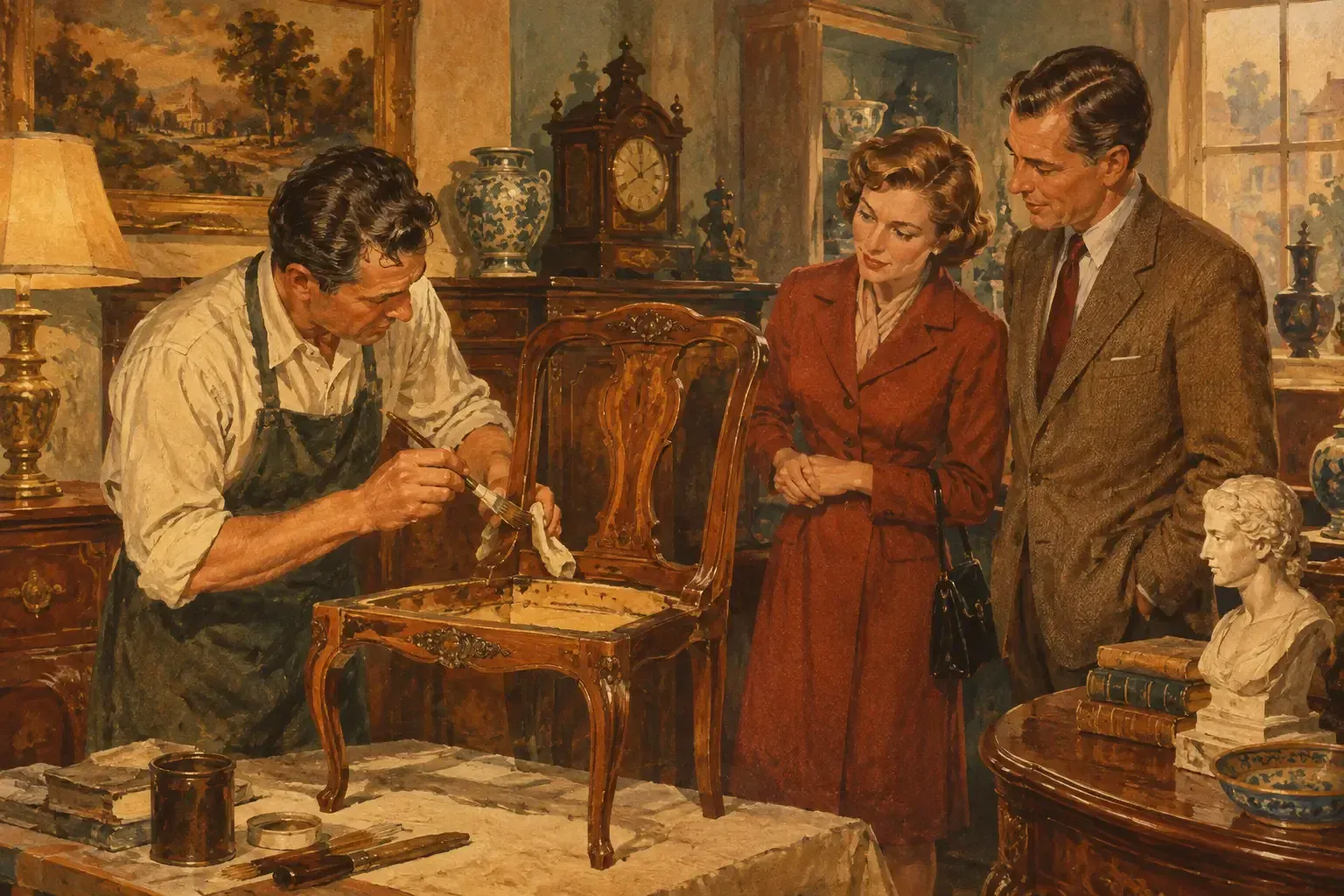
Look at the colour inside a loss. Fresh, pale wood around a repair may indicate recent work, while a darker, softened edge can suggest an older restoration that has settled into the finish. Neither is inherently negative. Good restoration protects the object and respects its original character; clumsy patching can interrupt its visual rhythm.
Do not confuse veneer with laminate
Veneer is real wood, with pores, variation and the ability to be carefully repaired or lightly refinished. Laminate is a manufactured decorative surface, often printed, bonded to board and sealed beneath a hard layer. It can imitate wood convincingly from a distance but lacks the tactile depth and unpredictable detail of timber.
Run your fingers lightly across the surface. Wood veneer may have subtle texture following the grain, particularly where the finish has mellowed. Laminate tends to feel more uniform. At a chipped edge, laminate can peel in a thin plastic-like sheet, while veneer breaks as wood fibre.
This is especially useful when considering mid-century style furniture. Genuine period pieces often used quality veneers beautifully; modern lookalikes may use printed finishes. A label, maker’s mark and the overall standard of construction can help complete the picture.
Why veneered furniture deserves a place at home
The appeal of veneer lies in its ability to turn timber into decoration. A large, carefully matched walnut top can bring movement and warmth to a dining room. Rosewood cabinet doors can add depth to a restrained modern scheme. On Georgian and Victorian furniture, veneer can preserve precious decorative woods while revealing the taste and technical confidence of its era.
For buyers, the practical consideration is condition. Keep veneered furniture away from radiators, strong direct sunlight and persistent damp. Use coasters, wipe spills promptly and avoid harsh silicone polishes. If a surface needs attention, seek advice before sanding: veneer is thin, and aggressive sanding can go through it quickly.
A piece should be valued for the whole of its story – its form, maker, materials, workmanship and survival – rather than reduced to a single construction detail. The most rewarding furniture often rewards a closer look. When the grain has been chosen with care and the structure remains sound, veneer is not something hidden beneath the surface. It is often the surface worth bringing home.