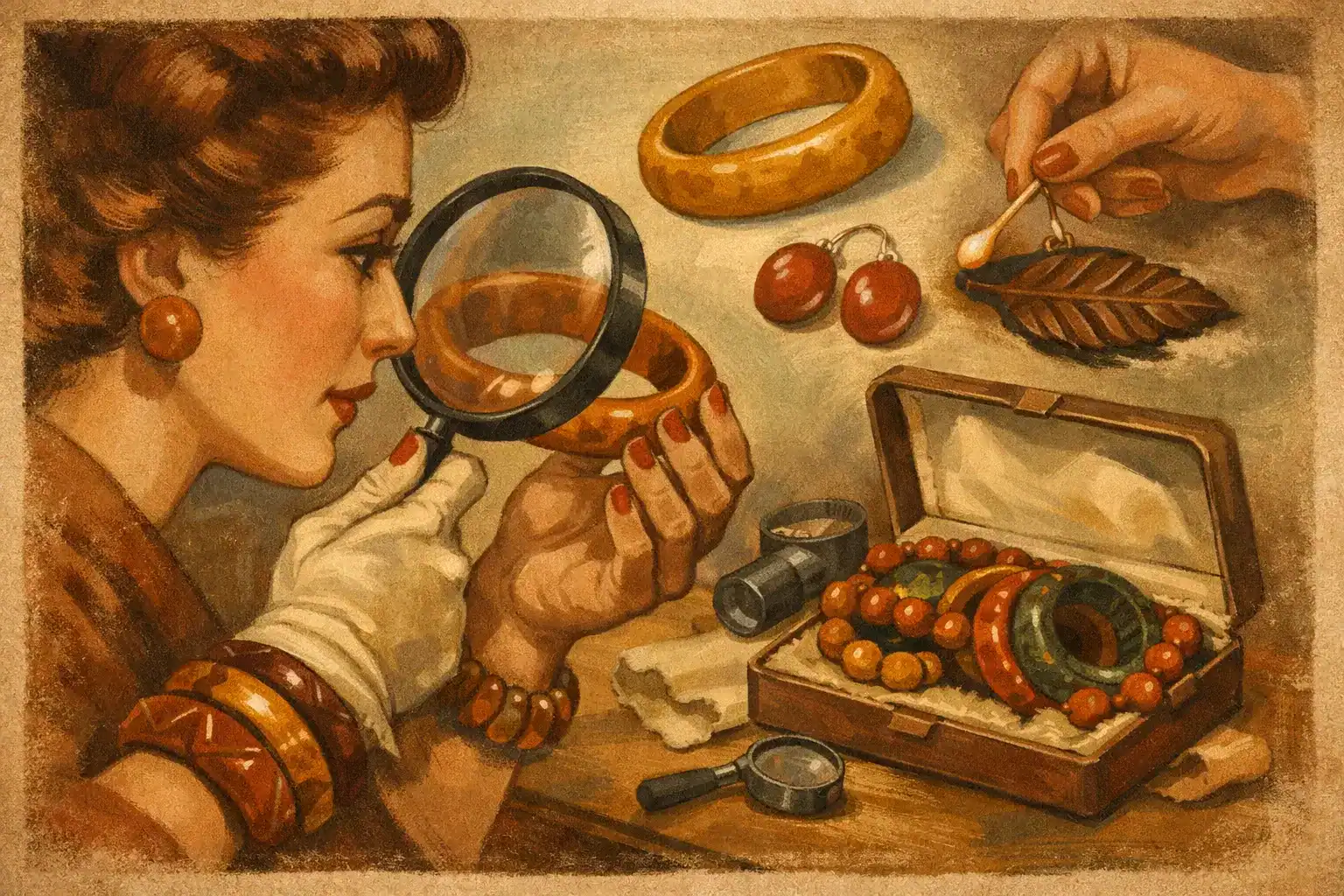
A deep butterscotch bangle, a carved cherry-red brooch or a string of weighty beads can bring an extraordinary amount of character to a simple outfit. Knowing how to identify bakelite jewellery helps you buy those pieces for their real history, rather than paying collectors’ prices for a later plastic imitation. The best judgement comes from looking at the whole object: its colour, feel, construction, ageing and, where appropriate, a discreet test.
Bakelite is one of the most recognisable materials of the early plastic age, but it is also one of the most misidentified. Vintage sellers may use the name loosely for almost any bold, retro plastic jewellery. For collectors, however, Bakelite means something rather more specific: an early phenolic resin, widely used from the 1920s and especially popular for jewellery in the 1930s and 1940s.
How to identify Bakelite jewellery by sight and touch
Start with the qualities that require no test at all. Genuine Bakelite often has a presence that newer plastic struggles to reproduce. It feels dense and substantial for its size, with a hard, smooth surface that is neither waxy nor lightweight. A bangle should have a pleasing solidity in the hand; a brooch should not feel thin, hollow or flimsy.
Colour is one of Bakelite’s great attractions. Pieces were made in rich, saturated shades including butterscotch, tomato red, apple green, deep blue, black and marbled combinations. Ageing can be just as revealing. Yellow, cream and pale green pieces may develop a warmer, more honeyed surface over time, while darker colours can gain a soft depth rather than remaining perfectly uniform.
This does not mean every genuine piece must look old. Well-kept jewellery can retain a remarkably fresh finish, and some colours change more noticeably than others. Equally, a convincing colour alone proves very little. Modern resin makers can produce vivid marbling and attractive translucency, so treat colour as one clue within a wider assessment.
Look for purposeful carving and construction
Many desirable Bakelite pieces were made with carving, layering and geometric forms that suited the Art Deco and wartime fashions of the period. Expect chunky bangles, dress clips, brooches, buttons, earrings and bead necklaces. Carved leaf motifs, dots, stars, fruit, animals and deeply cut abstract patterns are all seen, although rarity and quality vary greatly.
Study the reverse as closely as the front. Carving on authentic pieces tends to feel intentional and clean, even where wear has softened the edges. Laminated or laminated-looking jewellery may reveal separately coloured layers, carefully cut to expose the contrasting material beneath. On brooches and dress clips, original metal fittings can offer useful context: look for sturdy, period-appropriate pins, rivets and clasps rather than bright modern hardware hastily attached to an old-looking plastic form.
Wear should make sense. Gentle rubbing at the edges, light scratching and a mellow polish are consistent with decades of use. Crude seams, obvious mould marks, sticky surfaces or an artificial-looking distressed finish deserve closer scrutiny. They do not automatically rule a piece out, but they should slow the buying decision.
The tests collectors use, and their limits
Visual examination should always come first. If a piece has good colour, weight, construction and credible age, a test can support that impression. No single test is flawless, particularly with altered, repaired or heavily polished jewellery, so avoid treating any one result as a guarantee.
The warm-water scent test
One traditional method is to run warm water over an inconspicuous area, then smell the piece. Bakelite may release a distinctive odour often described as formaldehyde, phenolic resin, antiseptic or slightly medicinal. It is not a perfume-like scent, but once recognised, it can be memorable.
Use warm water rather than boiling water, and dry the jewellery immediately. This test is better suited to solid bangles or beads than to a brooch with delicate fittings, glued elements or a vulnerable finish. It can also be inconclusive on very small pieces, heavily cleaned items and dark colours. Never soak jewellery simply to force a result.
The polish test
Collectors sometimes use a tiny amount of Simichrome polish on a cotton bud, gently rubbed on a hidden area. A yellowish residue is commonly taken as evidence of Bakelite. While useful in experienced hands, it is not a test to apply casually to every purchase. Polish can leave residue, affect a finish and create needless risk on painted, lacquered or decorated surfaces.
If you choose to use it, test the least visible spot, use almost no pressure and stop immediately if the surface appears coloured, fragile or unusually dull. It is sensible to avoid this method on jewellery with applied decoration, glued stones, metal embellishments or strong collector value. In many cases, the wiser approach is to ask a specialist dealer for clear photographs and a reasoned attribution.
The hot-pin test is not worth the damage
You may see advice suggesting that a heated pin should be pressed into plastic to detect Bakelite. Do not do this. It damages the piece, can leave a permanent mark and is unnecessary when better, non-destructive methods are available. Jewellery survives as part of its history; a test should never compromise the object it is meant to verify.
Bakelite lookalikes that catch buyers out
Several materials can resemble Bakelite, especially in online photographs. Celluloid is an earlier plastic often found in jewellery, combs and vanity objects. It can be lighter and more translucent than Bakelite, but it is also unstable and highly flammable. Never use heat-based tests on suspected celluloid.
Catalin is another term that causes confusion. It is closely related to Bakelite and is often used by collectors to describe cast phenolic resin jewellery, particularly brightly coloured or translucent pieces. In everyday antique trade language, both may be sold under the broader Bakelite label. The distinction can matter to specialist collectors, but a transparent description of material, colour and condition matters more than forcing certainty where the evidence is limited.
Modern resin, acrylic and injection-moulded plastic are the commonest substitutes. They may look excellent in a listing image but often feel too light, too uniform or too glossy in person. Their fittings can also give them away. A shiny modern rollover clasp, a perfectly crisp mould seam or a hollow, thin back should prompt questions.
Galalith, made from casein, can also be mistaken for Bakelite. It was used for buttons and some jewellery, and has a handsome, dense quality of its own. It deserves appreciation rather than dismissal, but it should be identified and priced correctly. The aim is not merely to acquire a famous name. It is to understand the material and design in front of you.
Assess condition before you assess value
An authentic Bakelite bangle with a hairline crack is still authentic, but its value and long-term wearability will be affected. Hold bangles to the light and inspect the inner rim, where stress fractures can hide. Check beads for chipped drill holes and examine brooches for repairs, replaced pins, missing clips or glue around carved details.
Some surface marks are part of the charm. Fine scratches, slight dulling and gentle discolouration often reflect an honest life and can be polished only by a conservator who understands the material. Deep gouges, unstable cracks and poorly executed repairs are different matters. A rare design may justify careful purchase despite condition issues, whereas a common piece should be priced with those faults plainly in mind.
For colour-changing pieces, be wary of aggressive polishing. A beautiful aged patina can be removed in minutes, leaving an object brighter but less interesting. Originality is often more valuable than a freshly buffed finish.
Buying with a collector’s eye
When buying online, request views of the front, reverse, clasp, edges and any damage. Ask whether the piece has been tested, which method was used and whether there are repairs or alterations. A trustworthy description should distinguish between confidence and certainty. Phrases such as “tested Bakelite”, “attributed to Bakelite” and “Bakelite-style” do not mean the same thing.
At MN Interior Antiques, we value the details that allow an object to be enjoyed with confidence: material, condition, period character and the small signs of craftsmanship that make one vintage piece more compelling than another. Bakelite jewellery is at its best when it is both collectible and wearable, whether displayed among decorative objects or chosen as the one vivid accent in a considered wardrobe.
The most satisfying finds are rarely secured by one clever trick. Train your eye, handle examples whenever possible, and allow provenance, condition and design to guide you alongside testing. A genuine piece carries more than a famous material name – it carries the bold optimism and inventive spirit of its era.