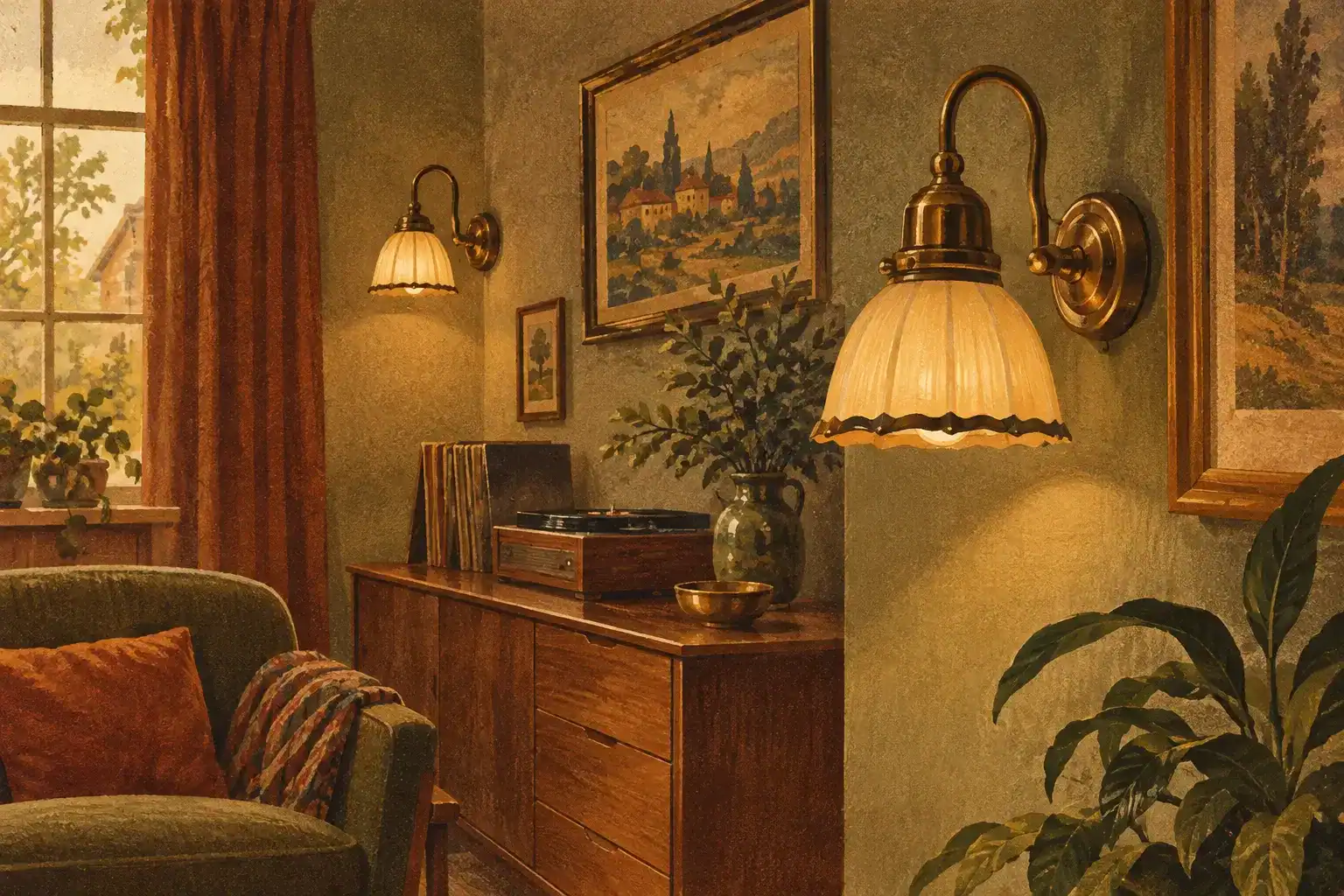
A wall light has a particular kind of presence: it sits at eye level, catches the evening glow and makes even an ordinary passage or bedside feel considered. The best vintage wall lights UK buyers can find do more than fill a dark corner. They introduce material, proportion and a visible trace of design history into a room.
Unlike a new fitting made to disappear, a well-chosen vintage sconce can become part of the architecture. A pair of 1930s bronze uplighters lends ceremony to a chimney breast; slim 1960s teak-and-glass lights bring warmth to a reading nook; an industrial enamel shade gives a utility room or kitchen an honest, practical character. The right choice depends less on following one period faithfully and more on recognising what a room needs.
What makes a vintage wall light worth seeking out?
Originality matters, but it is only one part of the appeal. The most successful pieces combine a strong silhouette with materials that improve with age: patinated brass, opaline glass, painted metal, ceramic, timber or hand-worked iron. Their details tend to be more deliberate too. Look for a pleasing backplate, a well-balanced arm, neat joins and shades with a proportion that feels right from every angle.
Condition is equally significant. Surface wear is often desirable, particularly on brass or painted metal, because it gives a fitting depth that cannot be replicated by an artificially aged finish. What should give pause is structural damage, severe corrosion, cracks around a glass shade’s fixing points or missing components that would be difficult to replace. A small chip on an old glass shade may be acceptable in a secondary room; it may be less so on a matched pair intended for a formal hallway.
Provenance can add interest, especially with British makers, European mid-century lighting and reclaimed architectural fittings. Yet a light does not need a famous name to deserve a place in your home. The quality of the object, its rarity and its relationship with the room are often more meaningful than a label alone.
Best vintage wall lights UK homes can use by style
Mid-century sconces for softer, sculptural light
Mid-century wall lights are especially versatile in contemporary British interiors. Designs from the 1950s to 1970s often use teak, brass, smoked glass, opaline shades or coloured metal, with crisp lines and an appealing economy of form. Adjustable reading lights and twin-arm sconces work beautifully beside beds, while folded-metal uplighters can soften a sitting room without taking up floor space.
The trade-off is that some period shades produce a more atmospheric than task-focused light. If you need to read in bed, choose an adjustable fitting with a directed shade rather than relying on a decorative uplighter. Keep the scale in mind too: a tiny 1960s sconce can look lost above a generous king-size bed, even if its design is exceptional.
Antique brass and bronze for depth and permanence
For Georgian-inspired, Victorian or layered country-house schemes, antique brass and bronze wall lights offer weight and warmth. Candle-style arms, reeded backplates and aged metal work naturally beside antique furniture, old timber floors and richly coloured walls. They also provide a useful counterpoint in cleaner spaces, where one carefully chosen traditional fitting can prevent a room from feeling overly new.
Avoid polishing away the very quality that makes these pieces special. Gentle cleaning is usually enough. The darkened recesses and softer highlights of old brass reveal its age and give the fitting visual depth. If the room already has many ornate elements, select a simpler single-arm design rather than adding another elaborate flourish.
Opaline glass for hallways, landings and bathrooms
Opaline and milk-glass shades have a quiet, flattering quality. Their softly diffused light suits corridors, stair landings and bedrooms, where glare is unwelcome. Art Deco examples, often paired with chrome or brass, can feel both decorative and restrained. A matched pair framing a mirror or doorway brings order to a room without becoming overly formal.
Authentic period glass may show faint mould lines, tiny bubbles or gentle variation in tone. These are signs of production rather than faults. Check that the shade sits securely within its gallery and that any gallery screws are present and functioning. For bathroom use, a beautiful old fitting must also meet the appropriate safety and ingress-protection requirements for its position. A specialist electrician can advise whether a chosen light is suitable or whether a similar look is better placed just outside the regulated zones.
Industrial and architectural salvage lights for useful character
Factory lights, former school fittings and reclaimed bulkheads bring a more utilitarian note. Their appeal lies in function: enamelled shades direct light exactly where it is required, while cast-metal bases and wire guards introduce texture. They suit boot rooms, pantries, utility spaces and kitchens particularly well, but one can also look striking against plaster walls in a modern dining room.
Industrial does not have to mean oversized. A pair of compact enamel sconces can add more character than a large statement fitting, particularly in a low-ceilinged cottage or narrow galley kitchen. Consider how the shade projects from the wall before buying. A fitting that extends too far into a busy walkway is impractical, however handsome it may be.
How to choose the right scale and placement
Wall lighting is often chosen late in a scheme, when it should be considered alongside furniture and artwork. Start with its purpose. Ambient lighting benefits from shades that cast light up, down or through glass. Task lighting needs direction and should sit close to where it will be used. Decorative lighting can be gentler, provided the room has other light sources for darker evenings.
Beside a bed, position lights so their switches and shades are comfortably reachable when seated. In a hallway, place a pair at a consistent height that relates to nearby door frames, mirrors or pictures. Either side of a fireplace, symmetry usually works best, although deliberately mismatched antique fittings can be effective in an informal room when their scale and finish have something in common.
A wall light should not compete with every object around it. If a room already contains a bold rug, patterned upholstery and antique ceramics, a simple metal or opaline-glass fitting may give the eye somewhere to rest. Conversely, a plain room with limewashed walls and restrained furniture can carry a more expressive Italian mid-century sconce or decorative French brass design.
Wiring, restoration and the details that protect your purchase
Vintage lighting should be assessed as both a decorative object and an electrical fitting. Old wiring, brittle insulation, loose lampholders and improvised connections are not reasons to dismiss a piece, but they are reasons to budget for professional re-wiring. Many vintage lights have been sympathetically restored with modern cable and appropriate fittings while preserving the original backplate, arm and shade.
Ask whether the light has been rewired, whether it is supplied with a ceiling or wall fixing plate, and what bulb type it takes. Bayonet-cap fittings are familiar in many British homes, while some European lights use Edison-screw bulbs. Low-heat LED bulbs are often a sensible choice for older shades, particularly delicate painted metal, fabric or small opaline glass, but choose a warm colour temperature if you want the gentle character associated with period lighting.
For anyone searching for vintage lighting Hertfordshire, viewing a piece closely can be particularly valuable. You can judge the colour of aged brass, the translucency of glass and the true depth of a fitting in a way that photographs do not always convey. Detailed images and clear condition notes remain essential when buying online, especially for pairs where small differences may matter.
Building a room around a vintage wall light
The strongest interiors rarely depend on everything being from one era. A 1930s glass wall light can sit comfortably beside a mid-century sideboard; a 1970s brass sconce may bring warmth to an older cottage. Repetition creates cohesion: echo brass in picture frames or cabinet furniture, pick up the soft white of opaline glass in a ceramic lamp, or balance an industrial fitting with aged timber and linen.
Choose the light that makes you look twice before it is switched on. Once installed with care, a vintage wall fitting will do more than illuminate the room – it will give the walls a story to tell each evening.