A good vintage light does more than brighten a corner. It sets the visual temperature of a room, catches the eye before furniture has a chance to speak, and quietly tells a story about the period that made it. In the question of Art Deco vs mid-century lighting, the difference is not simply old versus older. These are two distinct design languages, each with its own proportions, materials and sense of occasion.
For homes that favour character over catalogue-perfect matching, both styles offer lasting appeal. The right choice depends on the architecture of your room, the furniture already in it and whether you want your lighting to feel theatrical, sculptural, restrained or warmly informal.
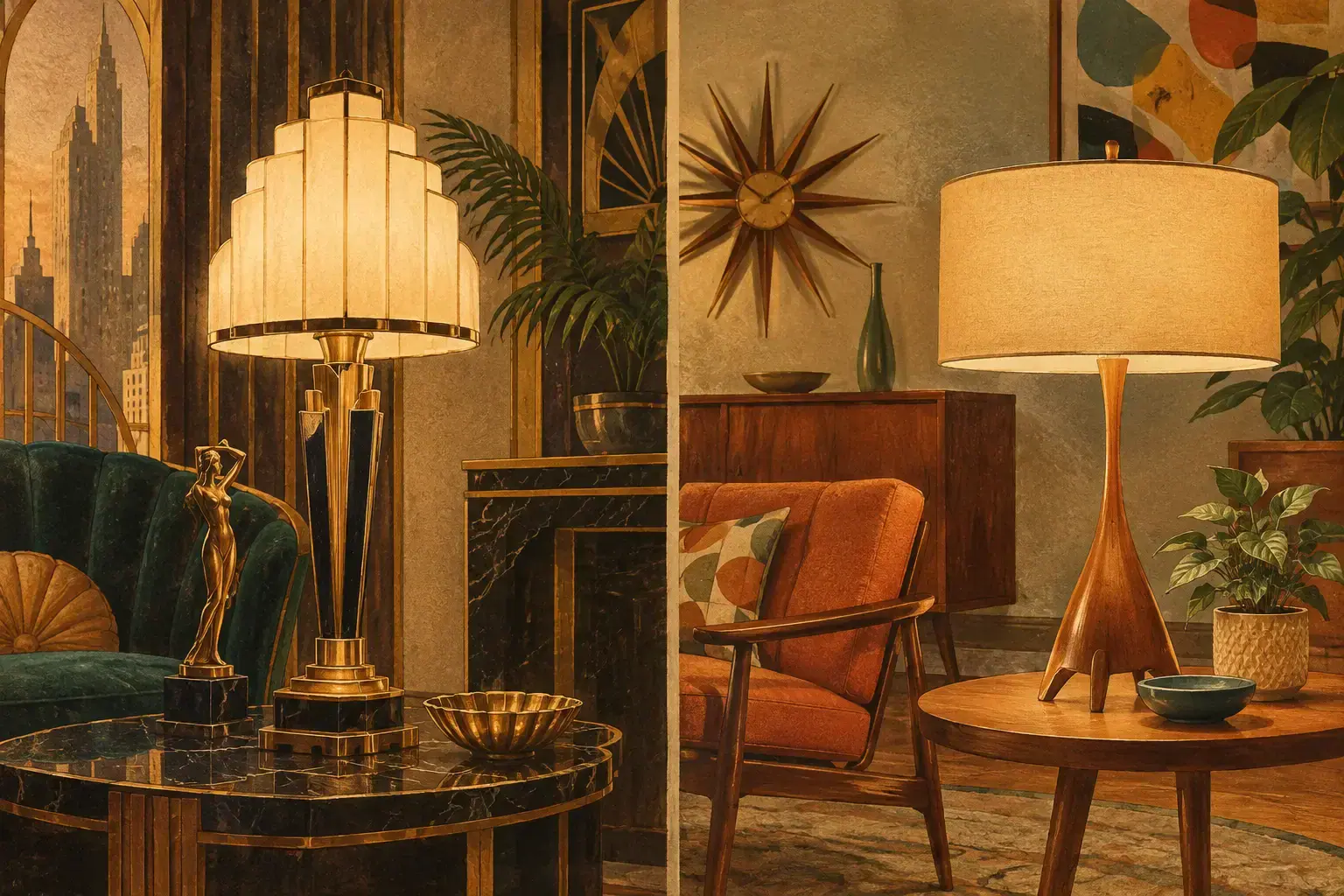
Art Deco vs mid-century lighting at a glance
Art Deco lighting belongs broadly to the interwar years, reaching its most confident expression during the 1920s and 1930s. It is a style of glamour, geometry and carefully controlled drama. Think stepped silhouettes, sunbursts, frosted glass, polished chrome, brass and strong vertical lines. A Deco pendant or wall light can feel almost architectural, even when it is modest in scale.
Mid-century lighting, by contrast, emerged from the post-war optimism of the 1940s through to the late 1960s. It favours clean profiles, new manufacturing methods and a more relaxed relationship with everyday living. Teak, walnut, spun aluminium, coloured metal, opaline glass and boldly shaped shades all appear regularly. The forms may be simple, but they are rarely plain: a well-designed mid-century lamp has an unmistakable sense of balance.
The shorthand is useful, though not absolute. Art Deco is typically more formal and decorative; mid-century is usually more functional and experimental. Yet there are overlaps, particularly in chrome, glass and streamlined forms. Condition, maker and provenance should always take priority over a label applied too casually.
The visual language of Art Deco lighting
Art Deco lighting is for rooms that benefit from a little ceremony. Its geometry gives it a natural affinity with period houses, entrance halls, dining rooms and bedrooms where you want a decorative focal point without adding clutter.
Glass is central to the look. Skyscraper-shaped shades, ribbed or fluted glass, etched motifs and pale opaque panels soften light while retaining a crisp outline. Chrome and nickel were popular finishes, bringing a cool, reflective quality. Brass also appears, particularly in warmer English fittings and later Deco-inspired pieces.
The best examples have a pleasing sense of symmetry. A pair of wall lights framing a chimney breast, dressing table or bed can make a room feel considered and composed. A multi-arm ceiling fitting delivers more presence, but scale matters. In a low-ceilinged Victorian terrace or a compact hall, a close-fitting bowl or petite pendant may offer the same period character with less visual weight.
Art Deco is not always highly ornate. Many original lights are surprisingly pared back, relying on stepped metalwork or the quality of their glass rather than elaborate decoration. This restraint is one reason authentic pieces continue to sit comfortably in contemporary interiors.
Where Art Deco works best
Choose Deco lighting when the room has strong bones: original fireplaces, panelled doors, dark timber, plaster details or generous ceiling height. It also provides a handsome counterpoint in a newer home where the rest of the scheme is quiet. A single fluted-glass pendant above a dining table can introduce history without turning the room into a period set.
Its trade-off is formality. A large chrome chandelier can feel severe beside soft country furniture or heavily patterned fabrics. Introduce warmth through lampshades, wood, rugs or a mellow wall colour if the overall effect begins to feel too polished.
Why mid-century lighting feels different
Mid-century design brought lighting closer to the rhythms of daily life. Rather than presenting light as a fixed decorative feature, designers explored adjustable arms, directional shades, layered illumination and materials that could be mass-produced without losing personality.
Look for conical or dome-shaped shades, tripod bases, articulated reading lamps and globe pendants. Danish-influenced lights often pair timber with simple fabric or metal shades. Italian pieces may be more playful and sculptural, using lacquered metal, brass, coloured glass or dramatic multi-arm arrangements. British mid-century lighting ranges from practical 1950s utility fittings to elegant 1960s glass pendants.
A mid-century lamp tends to create a more relaxed composition than an Art Deco fitting. It looks at home beside a low teak sideboard, a woven chair or a piece of West German pottery, but it need not be confined to a strictly period scheme. A well-proportioned 1960s floor lamp can bring focus and softness to a modern sofa just as effectively.
The case for layered light
Mid-century interiors are particularly good at demonstrating that one central ceiling fitting is seldom enough. Combine a pendant for ambient light with a table lamp for intimacy and a directional floor or wall light for reading, art or a dark corner. The room immediately becomes more usable after dusk.
This approach is helpful in open-plan spaces, where a single large fitting can make everything feel evenly lit but emotionally flat. Pools of light define a dining area, reading chair or sideboard without the need for extra furniture.
Materials, patina and authenticity
Whether you are buying Art Deco or mid-century lighting, materials tell an important part of the story. Age should not be confused with neglect. Gentle wear to brass, light surface marks to painted metal or small variations in old glass can be entirely appropriate, often adding the depth that reproduction pieces struggle to imitate.
That said, condition deserves careful attention. Check that the glass is free from significant chips and cracks, that the shade sits securely, and that any mechanism moves as it should. Original labels, maker’s marks, switches and fittings can support attribution, although their absence does not automatically make a piece inauthentic. Many period lights were unmarked, particularly British domestic designs.
Rewiring is often sensible and should be treated as part of responsible restoration, not a loss of character. Vintage electrical fittings were made to standards of their time. Before installation, have a qualified electrician assess the wiring, earthing, bulb holder and ceiling support. This is especially relevant for older metal fittings and heavier chandeliers.
At MN Interior Antiques, the appeal of vintage lighting lies in this combination of decorative presence and tangible history. A carefully chosen fitting should feel lived with, not merely styled.
How to choose between the two styles
Start with the room, not the trend. If you have a formal dining room, a glazed vestibule or an elegant bedroom with traditional furniture, Art Deco may give you the clarity and atmosphere you are looking for. If the room is centred on teak, natural textures, broad windows and practical comfort, mid-century lighting will often feel more instinctive.
Then consider the shape of your existing furniture. Deco works well with upright cabinets, geometric mirrors and tailored upholstery. Mid-century pieces tend to complement low, horizontal forms, tapered legs and more open floor space. Contrast can work beautifully too: a small Deco table lamp on a mid-century sideboard adds polish, while a sculptural 1960s pendant can loosen a more traditional room.
Avoid forcing an entire room into one decade. The most convincing interiors usually have a thread rather than a rule. It might be a repeated finish, such as aged brass, or a shared shape, such as soft globes and curved edges. This is enough to make objects from different eras feel deliberately collected.
Practical questions before you buy
Before committing to a vintage light, take measurements of the room and the location where it will hang or stand. Ceiling height, cable drop and shade width are as important as appearance. A pendant over a dining table needs to illuminate faces and food without blocking sightlines; a bedside lamp should provide enough light to read without overpowering the room.
Also think about bulb choice. Warm white LEDs are generally kinder to period interiors than harsh, cool-toned bulbs, and they reduce heat near delicate shades. Filament-style LED bulbs can suit exposed-bulb fittings, but choose a shape that respects the scale of the original design.
For collectors and homeowners seeking vintage lighting in Hertfordshire, viewing the construction and condition closely is often more revealing than relying on a photograph alone. Weight, finish, the quality of glass and the way a fitting has aged are details worth noticing.
The most satisfying choice is the one that still feels right when the lamp is switched off. Whether you prefer Art Deco’s composed glamour or mid-century’s optimistic ease, choose a piece with honest materials, good proportions and a story that earns its place in your home.