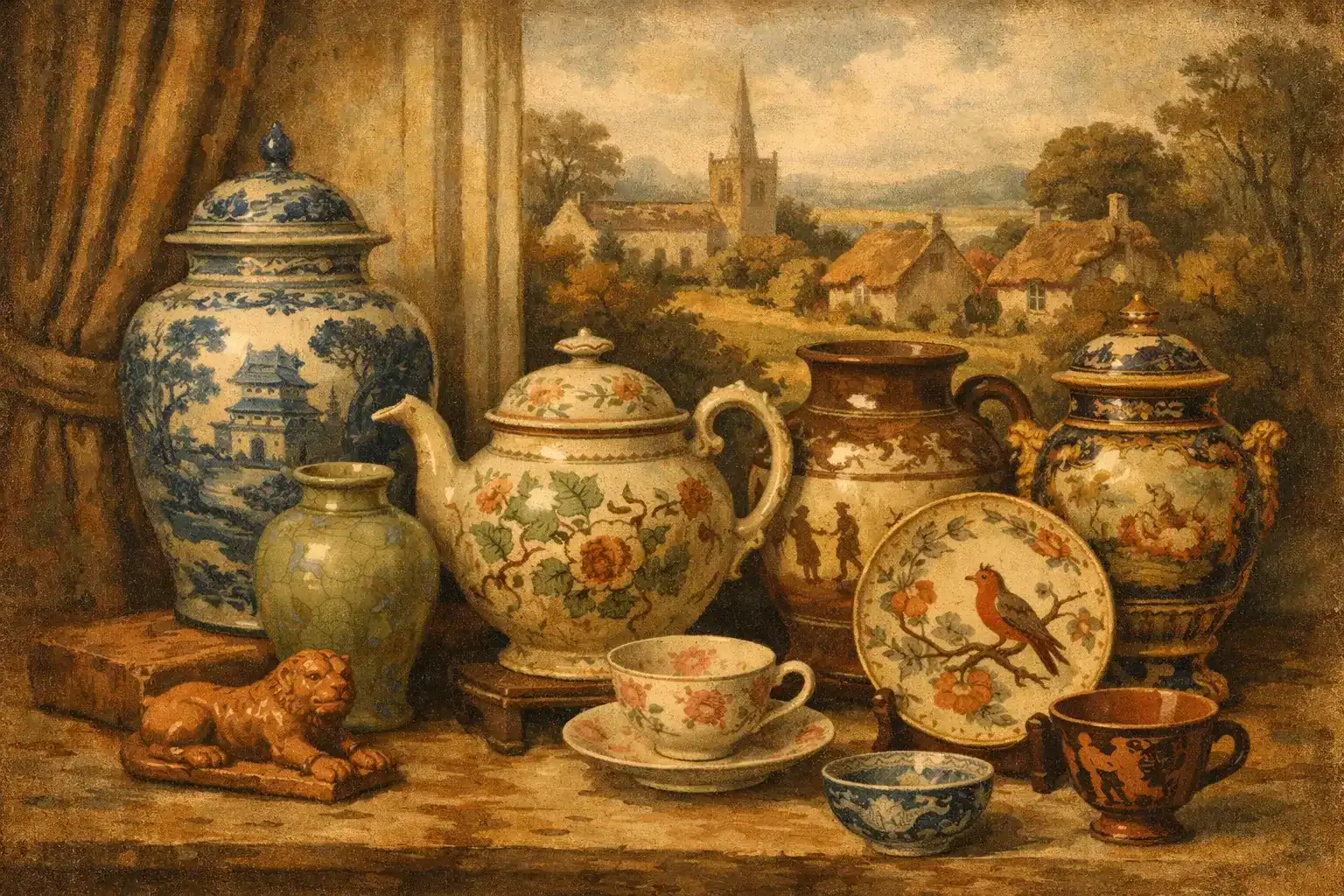
A glazed earthenware jug on a painted dresser, a pair of Staffordshire dogs on a chimney breast, or a richly textured vase catching the afternoon light can change the atmosphere of a room entirely. Our top 10 antique ceramics for Hertfordshire homes brings together pieces with genuine decorative presence, from country-house classics to expressive 20th-century studio forms. The right choice is not simply the oldest or rarest object. It is the piece whose scale, colour and history feel at home in the way you live.
Hertfordshire interiors often lend themselves particularly well to ceramics. Period cottages around Hitchin and St Albans can take traditional English pottery with ease, while the clean lines of Welwyn Garden City and more contemporary Stevenage homes provide a striking setting for bolder mid-century forms. A considered ceramic collection allows those worlds to meet without making a room feel over-styled.
Top 10 antique ceramics for Hertfordshire homes
1. Staffordshire pottery figures and spaniels
Victorian Staffordshire pottery is wonderfully characterful and immediately recognisable. Pairs of spaniels remain the familiar choice, traditionally placed either side of a mantel clock, but spill vases, cottages, animals and theatrical figures offer more individual routes into the category. Their charm lies partly in the hand-painted details and the slight variations that prove they were never factory-perfect in the modern sense.
Use a pair to give a fireplace or bookcase a sense of symmetry, or choose one larger figure as an unexpected accent on a hall console. Look closely for restoration to ears, tails and floral bocage, as these fragile raised details are frequently damaged. Professional restoration is not always a reason to walk away, but it should be reflected in both condition and price.
2. English transferware plates and platters
Blue-and-white transferware has a useful dual character: it is historic enough for a Georgian or Victorian house, yet graphic enough to suit a pared-back kitchen. Scenes of rural life, ruins and botanical borders bring detail without demanding bright colour. Brown, black, green and mulberry transferware can be equally compelling where blue feels too expected.
A single large platter makes a handsome display piece on a dresser or open shelf. For a more relaxed arrangement, group plates of related tone rather than trying to match every pattern. Crazing, light staining and small manufacturing imperfections are part of the appeal of early earthenware; active cracks and poorly disguised repairs deserve more caution.
3. Salt-glazed stoneware jugs
Salt-glazed stoneware has a quiet strength that rewards close looking. Its lightly textured, orange-peel surface was created by introducing salt into the kiln at high temperature, forming a distinctive glaze over the clay. German and British examples range from practical beer steins and tavern jugs to handsome utilitarian bottles with cobalt-blue decoration.
These are particularly good in kitchens, studies and dining rooms where a more restrained, earthy palette is wanted. They work well with oak, linen, old brass and painted wood. Choose a form with a strong silhouette – a rounded flagon, a ribbed jug or a tall bottle – rather than filling a shelf with too many small examples.
4. Majolica with botanical colour
For rooms that need a little life, Victorian majolica is hard to surpass. Its saturated glazes and moulded naturalistic forms celebrate leaves, fruit, shells, birds and pond life with theatrical confidence. A well-made dish can feel as sculptural as it is functional.
Majolica needs a considered hand. One substantial piece on a dining table, sideboard or kitchen wall is often more effective than a crowded collection. Check for glaze losses, chips to high points and later overpainting, especially around moulded leaves and handles. The best examples retain clarity in their modelling and richness in the pooling of the glaze.
5. Delft and Delft-style blue-and-white faience
Tin-glazed Delftware has a softness that separates it from crisp Chinese porcelain. Its painted scenes and floral motifs often have a charming irregularity, while the creamy white ground can warm a room more gently than stark modern ceramics. Plates, tiles, vases and chargers all have a place in an English interior.
A Delft plate on a stand adds a composed note to a mantel or cabinet, while antique tiles can be displayed in a framed panel rather than permanently fitted. Early pieces can show rim fritting, glaze wear and small chips, which may be entirely acceptable if the painting remains vivid and the form is sound. Condition matters, but so does the visual quality of the decoration.
6. Wedgwood Jasperware
Jasperware is a refined choice for those drawn to neoclassical detail. The familiar pale blue ground with white relief decoration is timeless, though sage green, black, lilac and deep blue examples can be more distinctive. Small boxes, plaques, bowls and urn-shaped vases sit comfortably in both formal and contemporary settings.
This is an excellent category for starting a collection because pieces are generally compact and easy to live with. Seek clean relief work and take time to inspect the edges of applied ornament. A hairline crack can be difficult to spot at first glance, so examine pieces in natural light and ask for clear condition details before buying.
7. Chinese export porcelain
Chinese export porcelain offers a direct link between global trade and British domestic history. Blue-and-white tea bowls, famille rose plates and armorial wares were made for overseas markets and later became part of dining and display traditions in Georgian homes. Their delicacy is balanced by an extraordinary decorative range.
A single tea bowl on a stack of books, or a carefully chosen plate in a cabinet, can have more impact than a large matched service. This is a category where authenticity and condition deserve particular attention. Look for honest wear to the foot rim and decoration, and be wary of pieces that appear suspiciously fresh without a clear explanation of age or restoration.
8. Arts and Crafts pottery
Arts and Crafts ceramics bring a welcome sense of handwork to an interior. British makers produced pieces with simple forms, muted glazes and an emphasis on material honesty, often in greens, ochres, blues and soft brown tones. The appeal is less about elaborate ornament and more about proportion, texture and the maker’s hand.
These pots sit naturally beside antique furniture Stevenage homeowners may already have chosen for its warm timber and craftsmanship. A low bowl on a coffee table or a tall vase on a chest of drawers can provide an understated focal point. Signed examples are desirable, but an unsigned piece with a beautiful glaze and convincing period character should not be overlooked.
9. Art Deco ceramics
Art Deco brought sharper geometry, elegant curves and a new appetite for stylised colour. Consider a crackle-glazed vase, a sleek faience figure, a shaped wall pocket or a strikingly patterned bowl. French, British and continental makers all interpreted the period differently, so there is plenty of room to buy according to taste rather than chase one recognisable name.
These pieces are especially effective in houses where original 1930s details survive, but they can also add discipline to a more eclectic room. Keep the display simple and give the silhouette space. A single Art Deco vase beside vintage lighting Welwyn Garden City buyers have selected for a reading corner can create a convincing, layered period moment.
10. West German Fat Lava pottery
Strictly speaking, much West German pottery is vintage rather than antique, but it belongs in any design-conscious ceramic collection. Produced mainly from the 1950s to the 1970s, these vases are celebrated for volcanic glazes, richly textured surfaces and emphatic forms. Their presence is immediate, whether in deep lava red, mustard, turquoise or black.
Fat Lava works brilliantly in mid-century interiors, but it also provides useful contrast in older homes where traditional timber and plaster need a livelier counterpoint. Check that the base marks are legible where possible, assess the glaze for cracks rather than harmless firing texture, and choose a vase shape that suits its intended position. A broad, squat example has a different role from a tall floor vase, even when the glaze is equally dramatic.
Choosing ceramics with confidence
Age alone does not make a ceramic desirable. Prioritise form, condition, surface and provenance, then consider how the piece will earn its place at home. A modest 19th-century platter with beautiful colour can be a better purchase than a rarer object that needs extensive restoration or has no visual relationship with your room.
Scale is often the deciding factor. Before buying, measure the mantel, shelf or table where the item will sit, and allow breathing space around it. Ceramics gather visual weight quickly. Three pieces with a shared colour or material can look intentional; ten unrelated objects can obscure the qualities that made each one worth choosing.
At MN Interior Antiques, the most rewarding pieces are selected for more than age or maker. They are objects with a story to tell, but also with the shape, finish and presence to become part of a lived-in home. Start with one ceramic that genuinely holds your attention, place it where it can be properly seen, and let the rest of the collection grow around it over time.